The Gokyo Ri Trek is a moderately challenging high-altitude trek that requires excellent physical fitness but no technical climbing skills. People often call the Gokyo Ri Trek a quieter version of Everest Base Camp. That’s true, but it doesn’t explain the Gokyo Ri Trek difficulty and how the trek feels. Yes, the trails are less crowded. Yes, the turquoise lakes are unreal. But if you strip away the Instagram filters and agency slogans, the Gokyo Ri Trek in 2026 is a moderate-to-challenging high-altitude trek that feels easy for some, brutal for others. It’s not technical mountaineering, but the combination of sleeping at high altitude for more than one night, a steep summit push on tired legs, and exposure to Himalayan weather makes the Gokyo Ri trek difficult.
The trek climbs above 5,300m in the Khumbu region. The higher you climb, the thinner the air gets. Breathing becomes harder, mornings are freezing, and some days involve long uphill walks and rough trails. The hardest part for most people is the altitude. Even strong hikers can struggle once the air gets thin. The trek can feel exhausting if you move too fast or skip proper acclimatization. At the same time, the trek is absolutely achievable for trekkers with decent fitness and those who take time and prepare properly.
This guide blends current (2025–2026) operator data, recent trekker reports, and practical experience to answer the questions that actually matter. You want to know:
- How hard is each day in real terms?
- What exactly makes Gokyo Ri challenging?
- Is the Gokyo Ri trek harder or easier than the EBC and other Everest treks?
- If you’re a beginner, can you realistically do it, and what Gokyo Ri training plan do you need?
Let’s go step by step on each:
What Is the Gokyo Ri Trek? (Route & Quick Stats)
Before talking about the difficulty of the Gokyo Ri Trek, you need a clear picture of what the Gokyo Valley trekking route actually includes.

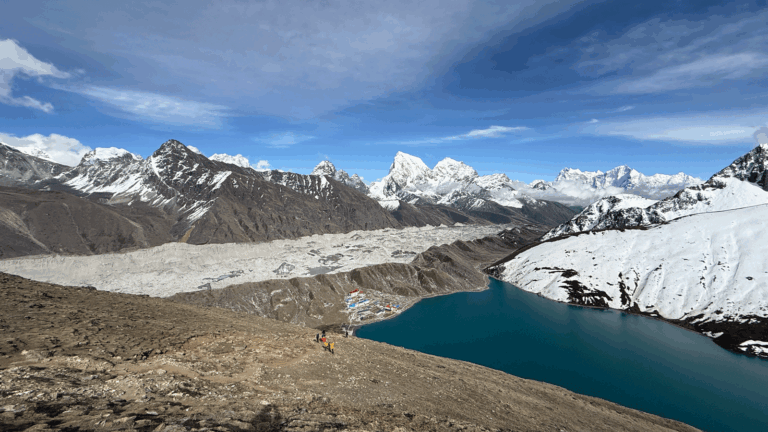
At its core, the Gokyo Ri Trek is a lodge-based trek in the Khumbu region (Everest region) of Nepal. The trek starts and ends at Lukla, the small mountain airport most Everest trekkers use. From Lukla, the Gokyo Ri trek route follows the Dudh Koshi valley through Phakding, Namche, Dole, and Machhermo, then to Gokyo village, and culminates at Gokyo Ri, a rocky viewpoint above the village, directly opposite the Ngozumpa Glacier and west of Everest.
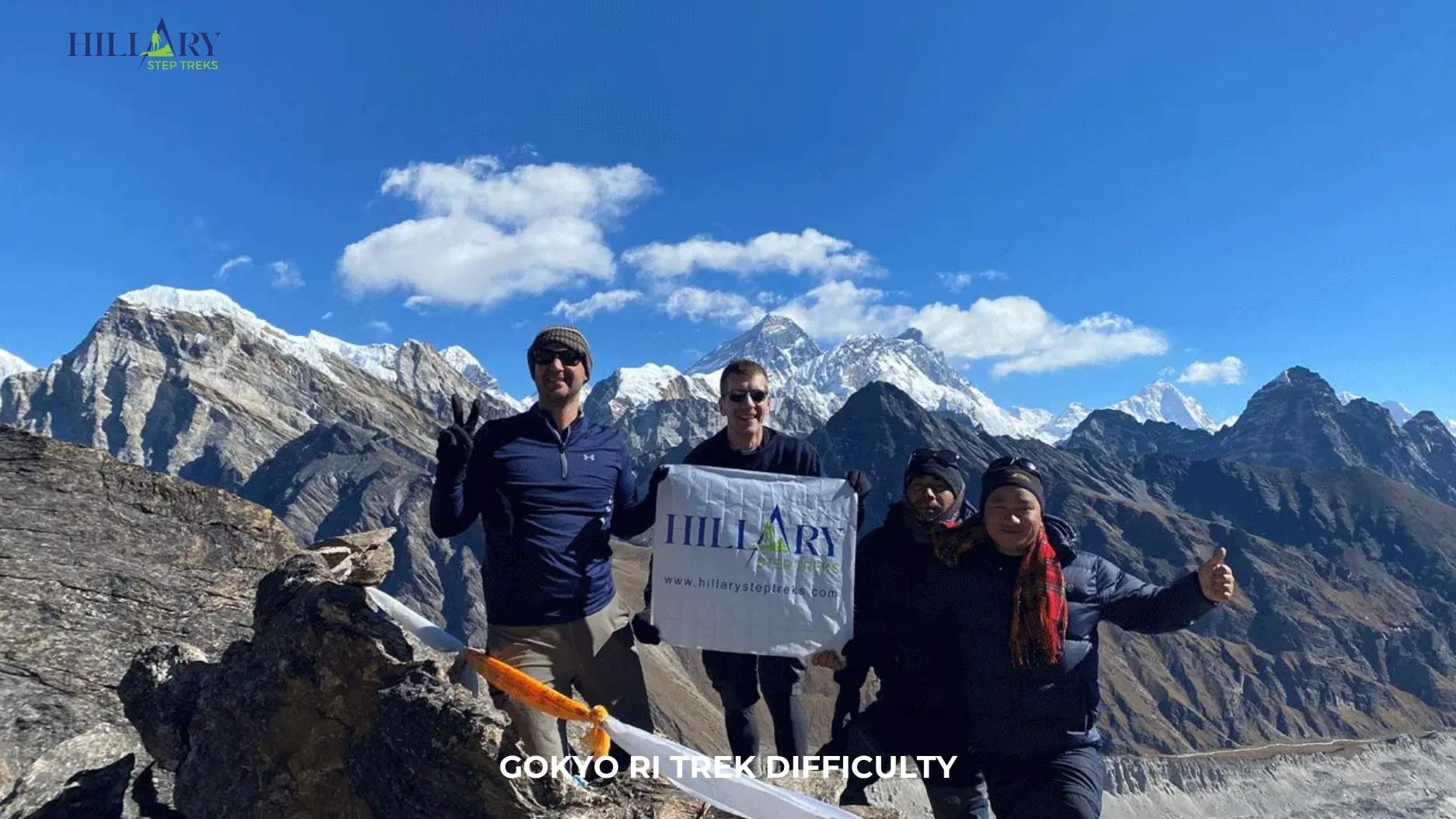
The main highlight of the trek is the sunrise climb to Gokyo Ri. From the summit, you can see Mount Everest, Lhotse, Makalu, and Cho Oyu in one panoramic sweep. Gokyo Ri is famous as the quieter alternative to the Everest Base Camp Trek.
Quick facts:
- Max altitude (Gokyo Ri altitude): 5,357m / 17,575ft
- Highest sleeping altitude: Gokyo village at 4,790m
- Trek duration: 10-14 days, depending on acclimatization days and side trips
- Daily walking hours: 5-7 hours
- Total distance: 90-100 km round trip
- Trek style: Non-technical walking, no ropes or climbing, but sustained steep sections and loose moraine
- Difficulty: Moderate to challenging
Gokyo Ri Trek Itinerary & Difficulty Level of Each Day
Without any doubt, one of the best ways to understand the actual challenge of the trek to Gokyo Ri is to look at its itinerary day by day. The difficulty changes constantly throughout the route. Some days are physically easy but mentally draining due to altitude. Others involve steep climbs that feel exhausting because of reduced oxygen.
Below is a breakdown of a standard Gokyo Ri itinerary.
Day 1: Flight to Lukla and Trek to Phakding:
- Difficulty: Easy
- Trekking hours: 4 hours
- Sleep altitude: 2,610m
- Terrain: Well‑marked path, a mix of gentle ups/downs along the Dudh Koshi.
What trekkers are saying in 2025–2026: Most people say this feels like a warm-up day. The walk is short and comfortable, so trekkers mostly focus on settling into the trek after the exciting Lukla flight. The biggest issue lately has been flight delays and weather problems at Lukla, which sometimes make schedules stressful before the trek even starts.
Day 2: Phakding to Namche Bazaar:
- Difficulty: Moderate to Hard
- Trekking hours: 7 hours
- Sleep altitude: 3,440 m
- Terrain: Forest trail, suspension bridges, and a long, steep climb before Namche.
What trekkers are saying in 2025–2026: This is the first hard day for most people. The final uphill climb to Namche feels longer and steeper than expected. Many trekkers say this is where they first notice the thinner air and heavier breathing. Guides now pay close attention to how people handle this day because it often shows who may struggle higher up.
Day 3: Acclimatization Day in Namche Bazaar:
- Difficulty: Easy to Moderate
- Trekking hours: 2-5 hours
- Sleep altitude: 3,440m
- Terrain: Short uphill hikes to places like Everest View Hotel or Khumjung village.
What trekkers are saying in 2025–2026: Most trekkers feel tired but better after doing a short acclimatization hike. Many report mild headaches or poor sleep at night, which is normal at this altitude. People who skipped walking and stayed resting in Namche often said they felt worse later in the trek.
Day 4: Namche Bazaar to Dole:
- Difficulty: Moderate to Challenging
- Trekking hours: 7 hours
- Sleep altitude: 4,110m
- Terrain: Climbing trail through forests, open hillsides, and quieter mountain paths.
What trekkers are saying in 2025–2026: Trekkers say this is where the trek starts feeling more remote and serious. The trail becomes quieter after leaving the Everest Base Camp route from Namche. Many people notice heavier breathing and lighter sleep because this is usually the first night above 4,000m.
Day 5: Dole to Machhermo:
- Difficulty: Challenging
- Trekking hours: 4 hours
- Sleep altitude: 4,470m
- Terrain: Open valley trail with gradual uphill walking and windy sections.
What trekkers are saying in 2025–2026: Even though the day is shorter, many people say it feels tiring because of the altitude. Small hills suddenly feel much harder. Trekkers also mention cold winds and lower energy levels here. Guides now remind people more often to drink water and keep eating properly.
Day 6: Machhermo to Gokyo:
- Difficulty: Challenging
- Trekking hours: 4 hours
- Sleep altitude: 4,790m
- Terrain: Rocky trail, glacier side paths, and uneven moraine sections before Gokyo.
What trekkers are saying in 2025–2026: Many trekkers say the rocky glacier area is slower and harder than expected. Snow and ice during colder months can make the trail more difficult. Still, most people describe reaching the blue Gokyo Lakes as one of the best moments of the whole trek.
Day 7: Gokyo to Gokyo Ri and Return to Gokyo:
- Difficulty: Challenging
- Trekking hours: 5-7 hours
- Sleep altitude: 4,790m
- Terrain: Rocky trail, glacier side paths, and uneven moraine sections before Gokyo.
What trekkers are saying in 2025–2026: Almost everyone says this is the hardest day of the trek. The climb feels slow because the air is very thin at this height. Many people stop every few steps to catch their breath. Trekkers also say starting too fast before sunrise usually makes the climb even harder. But the views from the top are often described as unforgettable and worth every step.
Day 8: Gokyo to Dole:
- Difficulty: Moderate
- Trekking hours: 6-7 hours
- Sleep altitude: 4,110m
- Terrain: Long downhill trail with rocky and uneven sections.
What trekkers are saying in 2025–2026: Breathing becomes easier while descending, but tired legs and sore knees become the new challenge. Many trekkers say they feel mentally relaxed after finishing Gokyo Ri, but they still need to stay careful on rough trails.
Day 9: Dole to Namche Bazaar:
- Difficulty: Moderate
- Trekking hours: 5-6 hours
- Sleep altitude: 3,440m
- Terrain: Forest paths, downhill trails, and rolling sections back toward Namche.
What trekkers are saying in 2025–2026: Most trekkers say this day feels much easier because of the lower altitude. Energy slowly starts returning, and sleep improves. Even so, many people mention sore knees and tired muscles after several long trekking days.
Day 10: Namche Bazaar to Lukla
- Difficulty: Moderate
- Trekking hours: 6-7 hours
- Sleep altitude: 2,860m
- Terrain: Long descent with suspension bridges, river paths, and final uphill sections before Lukla.
What trekkers are saying in 2025–2026: Trekkers say the final day feels long because the body is already tired. Many people are surprised that there are still uphill sections near the end. Even though the hardest part is over, guides still warn trekkers not to lose focus because slips and small injuries often happen on the way back to Lukla.
What Makes Gokyo Ri Challenging?
The Gokyo Ri Trek is difficult for several reasons, but altitude is the biggest factor. Many trekkers focus only on distance when preparing. In reality, high-altitude trekking changes how your body responds to effort, recovery, hydration, and sleep.
Here are the main factors that make the trek challenging.
Extreme Altitude and Thin Air
The main difficulty is thin air. From Lukla (2,860m) to Gokyo Ri (5,357m), you climb to a very high elevation in about a week. And after around 2,500m, the amount of oxygen in the air starts to drop. Because of this, you begin to breathe faster even while resting, your heart rate goes up with small effort, and your body gets tired much quicker than usual. Recovery after each day also becomes slower, and sleep is often light and broken.
By the time you reach higher places like Gokyo village (4,790m) and Gokyo Ri (5,357m), the oxygen level is roughly half of what you get at sea level. This is why normal activities feel much harder. A simple uphill walk that might take an hour at low elevations can take two to three hours here because every step feels heavier and slower.
Altitude sickness is also a real concern on this trek. It can affect anyone, no matter how fit they are. Common symptoms include headache, nausea, dizziness, low energy, loss of appetite, and poor sleep. Most trekkers feel at least some of these symptoms once they go above 4,000m.
The biggest mistakes trekkers make on this extreme altitude and thin air are rushing the ascent, skipping rest days, or pushing through strong symptoms like headache or nausea. At high altitude, this can be risky. Thus, guides in 2026 are more assertive about enforcing the “no more than 500-600m sleeping gain per day” rule and pushing clients to descend if symptoms don’t improve.
Crucial Summit Push and Steep Grade
The Gokyo Ri summit push from Gokyo village is where most trekkers realize why the Gokyo Ri Trek difficulty has its own category. The climb is not long in distance, but it is very steep and takes place at a very high altitude, which makes every step harder than it looks. You gain above 550m in a single push, usually in about 2 to 3 hours. The trail is made of loose rocks and gravel, with many zigzag turns going straight uphill. There are no flat sections where you can fully recover. It is a constant climb from start to finish.
Most trekkers start very early, often before sunrise, when it is cold and dark. The air is thinner at this time, and the body feels slower and heavier. Because of this, even strong trekkers move slowly and take frequent breaks. The cold wind near the top makes the climb feel even harder. This is the point where fitness really shows. If someone is used to long uphill hikes, they will still find it tough but manageable. If not, it can feel endless and exhausting. Many trekkers reach a stage where they must stop often just to catch their breath, even after only a few steps.
The climb is also mentally challenging. There are no easy sections to relax, so it becomes a slow, steady effort with no shortcuts. Some trekkers even think about turning back because the pace feels so slow and tiring. Even though the difficulty is high, nothing about the trail is technical. It is not climbing or mountaineering. It is pure uphill walking at high altitude, where the body is the main challenge, not the terrain.
In recent years, guides have started preparing trekkers mentally for this day in advance. They treat it like a “big test day” of the trek, where slow walking, patience, and steady breathing matter more than speed or strength.
Rugged Moraine and Glacier Crossings
Unlike the smoother paths lower in the Khumbu, the terrain near the Ngozumpa Glacier area constantly changes underfoot. You walk on rocky ground, loose stones, and uneven surfaces formed by old glacier movement. Several trekkers in 2025 travel forums specifically mentioned that this section felt more draining than longer trekking days because there is almost no rhythm to the walking.

The ground is unstable in many places, so every step needs attention. You cannot just walk normally like on forest trails. You have to watch where you place your feet all the time. This terrain also slows you down. Even if the distance is not long, progress feels slow because you cannot move quickly or smoothly. You keep adjusting your steps again and again, which uses more energy than expected. Over time, this creates fatigue in your ankles, knees, and hips, especially if you are carrying a heavy backpack. This part makes your body and mind tired.
The weather also changes how hard this section feels. In dry seasons, the trail is rough but manageable. In colder months or after fresh snow, it can become slippery and more confusing to follow. This makes walking even slower and more careful.
Cold Temperatures and Wind
Cold weather is another major reason the Gokyo Ri trek feels hard. Cold temperatures and wind can affect how your body feels and how much energy you have each day. At higher places above 4,500m, mornings are often below freezing. In colder seasons like late autumn and winter, the temperature can drop even more.
Even in spring and autumn, nights in places like Gokyo feel very cold, often below zero. In winter, it can become extremely cold, sometimes around -15°C or lower. During the day, it can feel warm in the sun, but the moment you step into shade or wind, the temperature drops quickly. This sudden change is something many trekkers do not expect.
Wind is another big problem, especially near Gokyo Ri and open ridges. Even a normal cold day can feel much colder when strong winds are blowing. This is called wind chill, and it makes simple walking feel more tiring and uncomfortable.
Cold weather also affects your body in small ways. You use more energy just to stay warm. Your throat gets dry, so you drink less water. This can lead to dehydration, which makes you feel more tired. After long walking days, recovery also becomes slower because your body is already working hard to maintain warmth.
Nighttime is often the hardest part. Most teahouses do not have heating in the rooms. Only the dining area usually has a stove. This means sleeping can be cold, especially if your sleeping bag is not warm enough. In very cold months, even water bottles can freeze inside rooms.
Fitness and Training Requirement for Gokyo Lake Trekking
One of the most common questions trekkers ask is whether beginners can complete the Gokyo Ri Trek. The answer is yes, but only with proper preparation and a decent fitness level. This is not an extreme trek, but it is also not a simple mountain walk, either. Trekkers who arrive unprepared (physically and mentally) struggle with long trekking days and altitude.
Let’s be blunt: you don’t need to be a professional athlete, but you do need to take training seriously. Below are some physical and mental training you can consider for the Gokyo Lake trek preparation:
Physical Training
A good Gokyo Ri training plan should focus on three things: cardio, strength, and hiking practice to build good physical conditions. If you can comfortably finish a 5 to 6 hours hike with a backpack and still feel okay the next day, you’re likely ready for Gokyo.
| Training Area | What to Do | Why It Matters |
|---|---|---|
| Cardio / Endurance | Fast walking, running, cycling, swimming, or stair climbing | Helps your body handle long trekking days, improve breathing |
| Train 3 to 4 times per week | Builds stamina and recovery | |
| 40 to 60 minutes per session | Improves overall endurance | |
| Add one longer workout each week (up to 90 mins) | Prepares you for back-to-back trekking days | |
| Strength & Stability | Squats, lunges, step-ups | Build leg strength for uphill climbs |
| Deadlifts, calf raises | Improve balance and stability | |
| Planks and core work | Support posture while carrying a backpack | |
| Train 2 times per week | Protect knees and reduce fatigue | |
| Hiking-Specific Training | Go on regular hikes with hills or stairs | Gets your body used to trekking movement |
| Start with short hikes and increase gradually | Builds confidence and endurance safely | |
| Carry a backpack during hikes | Prepares shoulders, knees, and feet for the trek | |
| Wear your trekking boots during training hikes | Helps prevent blisters and discomfort later |
Mental Preparation
Mental preparation is as important as building physical fitness. Fitness gets you through the trek. Meanwhile, mental strength helps you handle the hard days. Here are a few things to prepare mentally before the trek:
| Mental Challenge | What It Feels Like | What Helps |
|---|---|---|
| Long, tiring days | Walking for hours every day can wear you down mentally | Focus on one step at a time instead of the whole trek |
| Thin air and slow pace | Even small climbs can leave you breathless | Accept moving slowly |
| Cold and basic conditions | Cold rooms, simple food, and limited comfort | Accept that limited facilities are part of the experience |
| Weather and delays | Lukla flights and mountain weather are unpredictable | Stay patient and avoid stressing over changes |
| Bad days on the trail | Some days you may feel weak, tired, or unmotivated | Rest properly, eat well, and don’t panic |
| Comparing yourself to others | Faster trekkers can make you feel behind | Walk at your own pace and ignore the competition |
Gokyo Ri Trek Difficulty by Season
The season you choose can completely change how difficult the Gokyo Ri Trek feels, even though the route stays the same. In good conditions, the trek feels tough but manageable. In bad conditions, the same trail can feel exhausting, slippery, cold, and much more serious. Here, the main difference factors are the weather, trail condition, and how comfortable daily walking feels. Here’s what to expect in each season.
Spring (March to May)
Spring (March to May) is one of the best seasons for Everest Gokyo Ri trekking. In this season, conditions are mostly stable, and trekking feels smooth. Mornings are usually clear, while afternoons can bring light clouds. Furthermore, lower trails are decorated with blooming rhododendrons, which makes long walking days more enjoyable.
That said, early spring (March) can still have some snow patches around the moraine and near Gokyo Ri, but they are not technical if you have proper boots and trekking poles. By late April and May, the focus shifts to managing heat and dust in the lower sections, while higher up remains cool and comfortable for hiking.
Difficulty: Moderate
The trek still feels physically demanding, but weather and trail conditions don’t add much extra stress. Higher altitude remains the main challenge.
Autumn (September to November)
Autumn is the most popular trekking season in the Everest region, and for good reason. The air is clear after the monsoon, giving strong mountain views throughout the route. Days will be cool. Trails are generally dry and stable. Many trekkers rate October Gokyo trek conditions as near perfect, with views and trail quality at their best.
Later in the season, especially in November, temperatures drop sharply at night, and occasional early snow can make the Gokyo Ri climb slightly tougher. Also, crowds are higher than in Spring.
Difficulty: Moderate to moderately challenging
Physically similar to spring, but colder nights and busier trails can make it feel more tiring.
Winter (December to February)

The winter season is not the best time for trekking. Winter makes the whole Khumbu region quiet and harsh. Temperatures drop significantly, especially at night and early morning. Snow and ice often cover higher parts of the trekking trail, including the moraine and the climb to Gokyo Ri. Many lodges also close during winter, reducing flexibility on the trail.
Also, walking becomes more cautious on icy surfaces, and conditions can feel more serious than in other seasons. There will be fewer trekkers, and it is necessary to pack microspikes and warmer clothes.
Difficulty: Challenging
The trail itself doesn’t change, but cold, snow, and ice raise the effort level and risk. This season is best for those with prior winter trekking or mountaineering experience.
Monsoon (June to August)
Monsoon is the least popular season for the Gokyo Lake trek. It’s because rain affects the lower sections heavily, making trails muddy and slippery. Leeches can appear in forested areas. Higher up, clouds block mountain views for long stretches, and there is a possibility of landslides or wash-outs.
In worse conditions, you may not see big mountain views even from the Gokyo Ri viewpoint. There is also a higher chance of delays or disruptions due to weather and trail conditions.
Difficulty: Challenging
Not because of altitude, but because of wet, slippery trails, poor visibility, and safety on exposed sections. If your schedule is flexible, it’s usually smarter to avoid this window.
Comparing the Gokyo Ri Trek With Other Everest Region Treks
Many trekkers compare the Gokyo Ri Trek vs Everest Base Camp Trek, Gokyo Ri Trek vs Everest Three Passes Trek, and Gokyo Ri vs Mera Peak climbing to determine which best suits them. So, here is the simple comparison between them:
| Factor | Gokyo Ri Trek | Everest Base Camp (EBC) Trek | Everest Three Passes Trek | Mera Peak |
|---|---|---|---|---|
| Type of journey | Pure trekking with a high viewpoint climb (Gokyo Ri) | Classic Everest trekking route to base camp and Kala Patthar | Full high-altitude circuit crossing 3 major passes (Cho La Pass, Renjo La Pass, Kongma La Pass) | Trekking + mountaineering expedition |
| Overall difficulty | Moderate to challenging | Moderate to challenging | Very challenging | Hard / expedition level |
| Max altitude reached | 5,357m at Gokyo Ri | 5,545m at Kala Patthar | 5,500-5,800m (varies by pass) | 6,476m Mera Peak summit |
| Route structure | Lukla → Dudh Koshi valley → Gokyo villages → climb Gokyo Ri | Lukla → Namche → Tengboche → EBC → return same way | Loop covering Gokyo, EBC region + 3 high passes | Approach trek + glacier ascent to the summit |
| Terrain style | Mix of forest trails, rocky paths, moraine, and glacier views | Well-established main trekking highway in Everest region | Rough, remote, steep terrain with snow-covered passes | Glacier travel, fixed rope sections, steep snow slopes |
| Time at high altitude (4,500m+) | Moderate (few key nights) | Longer continuous exposure near EBC and Kala Patthar | Very long exposure across multiple valleys and passes | Short but intense exposure during the summit push |
| Physical demand | Strong daily climbs, especially the Gokyo Ri ascent | Long trekking days, but more gradual buildup | Continuous fatigue from the long route and repeated ascents | Very high effort due to altitude + technical climbing |
| Crowd level | Relatively quiet and peaceful | Very busy (especially peak season) | Moderate, varies by section | Very low (expedition groups only) |
| Technical skills needed | None (walking trek only) | None | None, but requires strong endurance and confidence in the snow | Basic mountaineering (crampons, rope, glacier travel) |
| Main difficulty factor | Altitude + steep summit day + moraine terrain | Long duration + altitude exposure + crowds | Cumulative fatigue + multiple high passes + remote terrain | Altitude + technical climbing + thin air at extreme height |
| Best suited for | Fit trekkers wanting views without technical climbing | First-time Everest region trekkers | Experienced trekkers wanting a serious challenge | Trekkers ready to step into real alpine climbing |
Tips To Successfully Complete Gokyo Ri Trek

As already discussed above, most problems on the Gokyo Ri trek in Nepal don’t come from distance. They come from altitude, poor pacing, and underestimating conditions. And if you want the trekking experience to feel tough but manageable instead of overwhelming, a few things matter more than anything else. Here are the key tips to successfully complete the trek to Gokyo Lakes:
- Don’t skip the Namche Bazaar acclimatization day. It helps your body adjust before going higher and reduces altitude issues later.
- Add an extra rest or easy day around Dole or Machhermo if you’re new to high altitude. It gives your body more time to adapt before you sleep at an altitude above 4,500m.
- After 3,000m, keep altitude gain slow (around 500-600m per night max). Faster ascend increase the risk of altitude sickness.
- Train consistently before the trek instead of doing random hard workouts. Include 3-4 cardio sessions per week + 2 strength sessions.
- Focus on cardio like walking, stairs, hiking, or cycling. These prepare you better than gym machines alone.
- Do practice hikes with a backpack for 5 to 6 hours before the trek. This is the closest match to actual trekking days.
- Carry a proper warm sleeping bag (around –10°C comfort or lower). Nights get very cold at higher altitudes, even in peak seasons.
- Bring a trekking pole for stability. It is especially useful for steep climbs and the descent from Gokyo Ri.
- Don’t rush. Slow pace and steady progress matter more than fitness level alone.
Guided Trek vs Solo Gokyo Ri Trekking: Which Is Right for You?
This choice is less about ego and more about how much risk and responsibility you want to carry on the trail.
Choose a guided trek if:
- It’s your first time in Nepal or your first high-altitude trek.
- You want someone else to handle logistics like permits, flights, and daily planning.
- You prefer not to worry about where to sleep or how far to walk each day.
- You want support if altitude sickness or injury shows up.
A trek guide helps set a steady, safe pace, understands weather and trail conditions better than most trekkers, and often makes better decisions about when to move or stop. This becomes very important above 4,000-5,000m, where conditions can change quickly.

Consider semi-independent or solo trekking if:
- You have already completed at least one major trek in Nepal or a similar high-altitude region.
- You are confident in handling navigation, pacing, and daily decisions on your own.
- You are comfortable managing permits, transport, and teahouse stays independently.
- You understand how your body reacts at altitude and can adjust without external help.
Even if you prefer to trek independently, hiring at least a porter will help you a lot. It reduces physical strain, helps you recover better each day, and lowers the chance of making mistakes caused by fatigue.
In 2026, more trekkers have started choosing guided trips even when they first planned to go solo. This shift is mainly because the Everest region has become busier in peak seasons, and conditions like weather changes, altitude issues, and lodge availability are easier to handle with local support.
Conclusion
The Gokyo Ri Trek is not easy, but it is achievable for most people who prepare well, respect the altitude, and give their bodies enough time to adjust. Some factors that make it challenging include high altitude, steep climbs to Gokyo Ri, glacier and moraine terrain, and long walking days over more than a week.
Nonetheless, the Gokyo Ri trek, aka the Gokyo Lake Trek, is suitable for trekkers who want big Himalayan views without the heavy crowds of the Everest Base Camp route. The final reward comes at sunrise on Gokyo Ri, where Everest, Lhotse, Makalu, and Cho Oyu rise above the turquoise Gokyo Lakes.
Frequently Asked Questions For Gokyo Ri Trek Difficulty
Expand AllHow hard is Gokyo Ri trek?
How long is Gokyo trek?
How difficult is the Gokyo Ri trek compared to Everest Base Camp?
What is the risk of altitude sickness on the Gokyo Ri Trek?
How long is the hike from Gokyo village to the summit of Gokyo Ri?
Is it legal to trek to Gokyo Ri solo?