
The Annapurna Base Camp trek map is crucial for the 7-day trek from Pokhara to ABC (4,130 m). It shows everything from the starting point, Pokhara, to the destination for each night: Ghandruk, Sinuwa, and Deurali, before reaching the main one, Annapurna Base Camp (ABC).
The trek map of Annapurna Base Camp contains different figures and symbols for trails, driving sections, trekking sections, rivers, lakes, and mountains so that you can navigate easily. Landmarks are named clearly. The blue lines denote rivers, dotted tracks denote driveways, and small mountain icons indicate the locations of Annapurna South, Machhapuchhre, and Tent Peak, with the mountains lying nearby. The legend is placed at the top left to make it easy for you to take a glance and get the gist of the ABC trail. For example, the numbering helps you determine the order of villages for overnight stays.
Hence, it is color-coded and a straightforward guide that makes the Annapurna Base Camp trek easier for first-timers or beginner trekkers. You can actually check the elevation changes without needing a guidebook or an internet search, which is unreliable most of the time. You can download this trek map and choose your own trek pace to the sanctuary.
Annapurna Base Camp Trek Map Summary
Your Annapurna Base Camp trekking journey begins with a jeep ride from Pokhara to Syauli Bazaar, the starting point of the trek. From here, the trail gently climbs up through terraced hillsides and traditional settlements along the Modi Khola until you reach Ghandruk (1,960m). This Gurung village is a famous tourist spot, situated on a hillside. It has stone-paved lanes, slate-roofed houses, and offers spectacular views of Annapurna South, Hiunchuli, and Machhapuchhre. You’ll spend the first night here.
On the second day, you’ll follow a trail that descends to the Kimrong Khola. Then, you’ll cross a suspension bridge before climbing back up to Chhomrong (2,150m), another lively village perched on a hillside. From here, you’ll descend again and continue upward to Sinuwa (2,360m) for the night, where the scenery shifts to lush bamboo and rhododendron forests.
Similarly, the third day will follow the Modi Khola upstream and take you through settlements like Bamboo (2,310m), Dovan (2,600m), and Himalaya (2,920m), until you reach Deurali (3,200m). In this section, you can see refreshing waterfalls cascading down cliffs. The sound of the river and the waterfalls will stay with you even at the ascent toward Deurali (3,200m). By this point, the tree line thins out, and the landscape turns more alpine, with sparse vegetation and steep rock walls on either side of the valley.
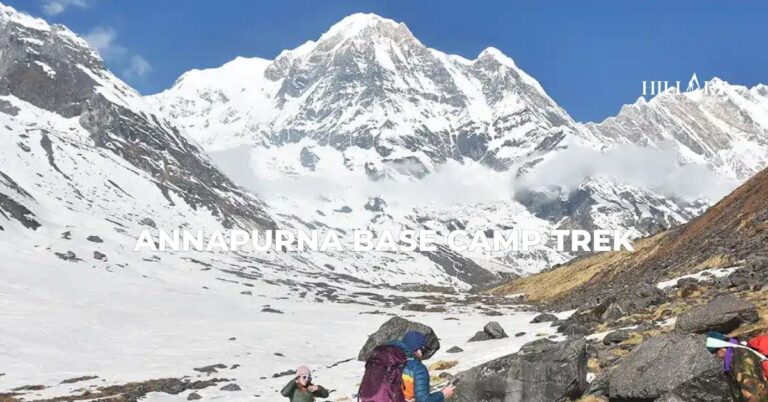
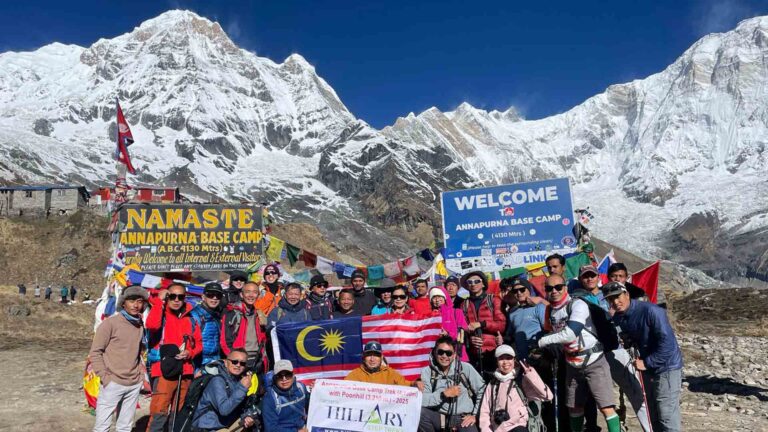
Finally, the fourth day will bring the highlight of the entire trek. You’ll leave Deurali and climb steadily through meadows and glacial streams to reach Machhapuchhre Base Camp (3,700m). You can admire the dramatic slopes of Machhapuchhre (6,993m) and then continue toward the sanctuary, Annapurna Base Camp (4,130m). Upon reaching here, you are rewarded with a mesmerizing amphitheater of peaks: Annapurna I (8,091m), Annapurna South (7,219m), Baraha Shikhar (7,647m), Tent Peak (5,695m), and Annapurna III (7,555m). They all surround you, giving you a stunning 360-degree view.
From the fifth day, you’ll start the return journey. You retrace the same trail, but the experience will be different: you’ll be satisfied and happier. The trail goes through Bamboo, and you’ll again be able to enjoy the natural hot springs at Jhinu Danda (1,700m). Then the next day, you walk back to Chhomrong and rejoin the jeep trail from here for the drive back to Pokhara through Birethanti and Syauli Bazaar, completing the circuit.
How is the Acclimatization and Altitude Adjustment on the ABC Trek?
Unlike higher-altitude expeditions like Everest Base Camp or the Annapurna Circuit Trek, the Annapurna Base Camp trek does not require a separate acclimatization day. It is a short, only a week-long trek, and the route itself is carefully paced. You begin in the lower villages around 1,500m and steadily rise to 4,130m at base camp, gaining 3,000m gradually. This slow gain helps your body adapt to changes in elevation without the need for long pauses.
Along the way, overnight stays in places such as Deurali (3,200m) and Annapurna Base Camp (4,130m) provide natural opportunities for rest and adjustment. These smaller sections break the climb into manageable stages, allowing trekkers to experience a healthy rhythm of walking and recovery before pushing higher into the alpine zone. Additionally, the trail combines both ascents and descents each day, so your body naturally conditions itself to thinner air.
However, you should still maintain a steady pace, drink enough water, and avoid caffeine and alcohol to support acclimatization. More importantly, pay attention to your health and look out for symptoms of altitude sickness like headache or nausea. With these additional precautions, you’ll get used to the progressive altitude gain, allowing you to enjoy the spectacular views with comfort and confidence by the time you arrive at Annapurna Base Camp.