
The Everest Three Passes Trek Route map is a visual guide to one of the most challenging circuits in Nepal. It shows the whole Khumbu region from Lukla to Everest Base Camp and the different routes you can take from Lukla, the starting point of the trek. With this map, you can see how the route flows from Kathmandu, check out the anticlockwise route, where rest days are planned, and how the trek forms a full circuit rather than a simple in-and-out trail.
You can also see the altitude profile and acclimatization stops. You can follow how the trail rises gradually from Namche Bazaar, pauses at villages like Chukung and Gokyo, and allows safe altitude gain before each high pass. Side trips such as Everest Base Camp, Kala Patthar, Chukung Ri, and Gokyo Ri are also marked, so you know these are both acclimatization hikes and major viewpoints.
Additionally, you trek through the cultural and spiritual sites like Tengboche Monastery, Pangboche Monastery, Gokyo Lakes, and Sherpa villages like Thame and Namche along the route. Basically, the map shows physical challenges, cultural landmarks, and high mountain scenery and gives you a clear sense of what the Everest Three Passes Trek is all about.
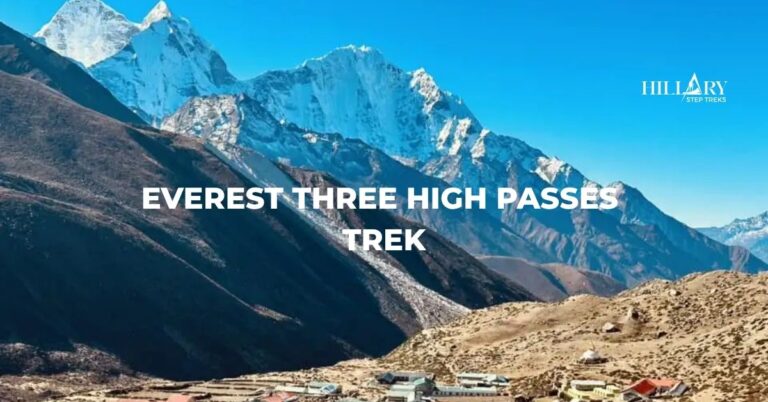
Everest Three Passes Trek Map Summary
The Everest Three Passes Trek begins in Kathmandu (1,350m) and includes preparations for the trek. Then, on the second day of the trip to Everest 3 high passes, you take a short but thrilling mountain flight that takes you to Lukla (2,860m), the gateway to the Khumbu. Right after the flight and a short rest, the route descends to Phakding (2,610m), which takes about 3 to 4 hours. Then, a longer 6-hour climb into the valley leads you to Namche Bazaar (3,440m). Namche is the bustling hub of the region and is also the first acclimatization stop. You can explore Khumjung or hike up to the Everest View Hotel for both culture and panoramas of the Everest and its surrounding peaks.
On the fifth day, the trail winds through rhododendron forests from Namche to Tengboche, home to the famous Tengboche Monastery. Then, you continue on to Pangboche (3,930m), which also has a monastery. This monastery is one of the oldest in the Khumbu, which adds a strong cultural experience to the trek. Then, the path climbs higher into the alpine zone on the sixth day via Dingboche to Chukung (4,730m). You take another acclimatization day here and hike to Chukung Ri (5,546m) for the sweeping views of Ama Dablam, Makalu, and Lhotse. The typical walking days in this section range from 5 to 7 hours, covering 10 to 15 kilometers, depending on the altitude.
Then, on day 8, you start the walk to the first major challenge of the trek, which comes with Kongma La Pass (5,535m). This eighth day is long and demanding, and can stretch up to 8 or 9 hours. The path often involves rocky climbs and moraine descents before arriving in Lobuche (4,910m). From here, the route joins the classic Everest Base Camp trail towards Gorakshep (5,160m). You finally reach Everest Base Camp (5,364m) and Kala Patthar (5,555m) after a short walk from Gorakshep. Stand beneath the Khumbu Icefall and witness the iconic sunrise view of Everest in the base camp and on Kala Patthar.
Next comes the second pass, Cho La (5,420m), which lies between Dzongla and Thagnak. This section is steep and icy, but the views make the effort worthwhile. You then continue toward the Gokyo Lakes (4,790m) on the twelfth day. This spiritual and high-altitude lake is a highlight of the trek, boasting turquoise waters. You spend an extra day here for rest and the climb up the nearby Gokyo Ri (5,357m), a viewpoint overlooking Cho Oyu, Everest, Lhotse, and the Ngozumpa Glacier.
Finally, the last challenge is Renjo La (5,360m). This pass is the lowest of the three but still offers one of the most dramatic panoramas of the trek, stretching from the Gokyo Lakes to the Tibetan frontier. From there on day fifteen, you descend down the route to Lungden (4,380m), from where you start the return journey to the historic Sherpa village, Thame, and eventually return to Namche. On day sixteen, the last stretch retraces the familiar path back to Lukla, where a short flight brings you to Kathmandu.
Completing this circuit involves walking 5 to 7 hours per day, but you get the satisfaction of having crossed all three high passes and experienced the wide Khumbu region: its peaks, valleys, monasteries, and the Sherpa people.
How is the Acclimatization and Altitude Adjustment on the Everest Three Passes Trek?
The Everest Three Passes Trek is tough not just for its length but also for its altitude. With three passes over 5,300m and several nights above 4,500m, acclimatization is key. To keep trekkers safe, the itinerary builds in three dedicated rest days.
The first acclimatization comes in Namche Bazaar (3,440m), where two nights give the body time to adjust. The gentle hikes to Khumjung village or the Everest View Hotel help with gradual exposure without the burden of heavy packs. The second acclimatization stop is at Chukung (4,730m), an essential pause before crossing Kongma La. You climb to Chukung Ri (5,546m) here, which helps condition the lungs for the higher passes ahead. The third is at Gokyo (4,790m), where a rest day and the option to summit Gokyo Ri (5,357m) prepare you for the final crossing of Renjo La.
Throughout the trek, the “climb high, sleep low” strategy is applied. For example, the hike to Everest Base Camp is done as a side trip from Gorakshep, letting trekkers touch 5,364m during the day but return to a slightly lower sleeping altitude. The same applies to Kala Patthar, which is climbed in the morning before returning to Gorakshep for recovery. This approach balances effort and rest, reducing the risk of Acute Mountain Sickness while making sure trekkers enjoy the big highlights in good health.
The map itself makes this strategy easy to follow, clearly marking locations and altitudes so you can estimate elevation gains, walking hours, rest stops, and the points where acclimatization days are built in. It ensures trekkers can see not just the physical route, but also how the rhythm of climb, rest, and recovery supports their safety and success on this demanding Himalayan circuit.