This Annapurna Circuit Trek Map gives trekkers a clear and practical overview of the entire journey around the Annapurna Massif. It doesn’t just trace the walking path but also highlights key landmarks, natural features, and cultural stops on the route. By following the map of Annapurna Circuit Trek, you can see how the trail flows from lowland valleys (Besisahar, Jagat, Dharapani) up through alpine terrain (Manang, High Camp, Muktinath, Jomsom) and across the high Thorong La Pass. From the pass, you walk back down into lush foothills (Ghorepani, Hile, Jhinu, Syomrong), encircling the Annapurna Sanctuary. So yeah, you can easily visualize the trek as a complete Annapurna Circuit Trek just by looking at the map.
We have placed a legend box on the top left to make the navigation easier. With that, you can easily distinguish the important symbols which denote trekking routes, mountains, locations, bridges, base camps, rivers, lakes, slides, driveways, paths, and also the trek days themselves. You can instantly spot altitude gains, day-to-day rest points, and river crossings. You can spot the cultural and natural highlights like Manang, Muktinath, Poon Hill, and the Kali Gandaki Valley.
Together, these details allow you to not only plan your walking days but also anticipate both the physical challenges and the scenic rewards along the Annapurna Circuit. Additionally, you can also see the 7 Days Annapurna Base Camp (ABC) Trek route via Bamboo, Deurali, and MBC to ABC. It helps you understand the exact difference in the itinerary of the Circuit Trek, the ABC trek, and the Annapurna Sanctuary Trek.
Annapurna Circuit Trek Map Summary
The Annapurna Circuit trek begins with a drive from Kathmandu to Bhulbhule via Besisahar (760m). From here, the route follows the Marsyangdi River valley, gradually climbing through terraced farmland, waterfalls, and traditional Gurung and Tamang villages. The map highlights the early stops at Jagat (1,300m) on the 2nd day, Dharapani (1,860m) on the 3rd, and Chame (2,670m) on the 4th. You’ll notice huge cultural differences between the lower Hindu hill communities when you arrive at Chame, a Tibetan-influenced Buddhist village.
From Chame, the circuit route enters alpine scenery and climbs to Upper Pisang (3,300m) on the 5th day. After that, on the 6th day, you have two options: the high trail via Ghyaru and Ngawal or the lower direct path via Lower Pisang and Humde. The first one offers better and more expansive mountain views. The latter is a shorter and less intense path. They both converge in Braga (3,440m) and follow the same trail to Manang (3,540m). It is one of the largest high-altitude settlements in the Annapurna region.
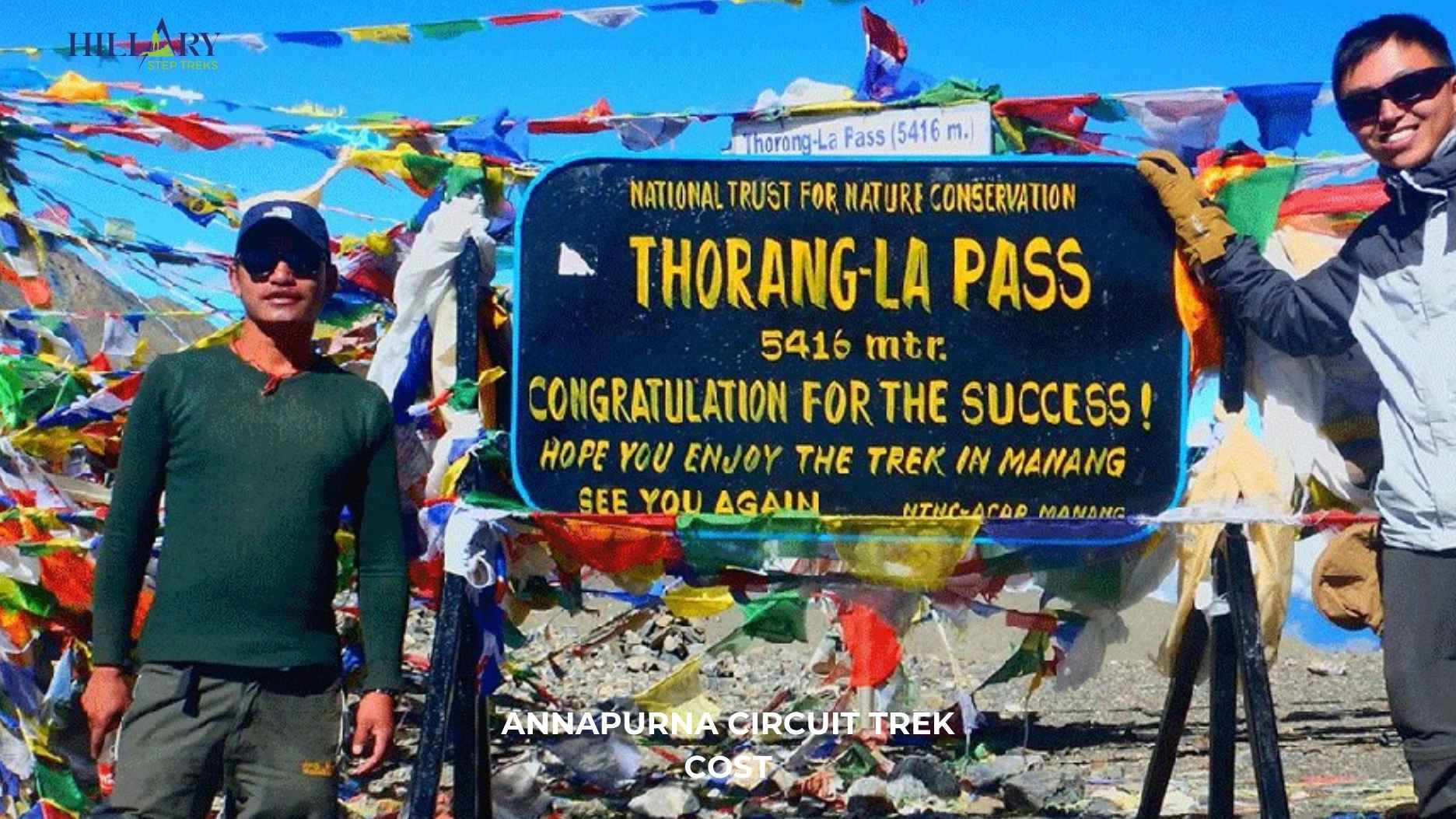
You’ll spend the 7th day here for acclimatization and rest in Manang Village. On the next 8th and 9th day, the trek gradually ascends to Ledar (4,200m) and High Camp (4,925m). Then, from the high camp, you need to descend via the Thorong La Pass (5,416m) on the 10th day. It takes you to the highest point of the trek. Naturally, it is also the most demanding day, which requires a pre-dawn start, long ascent, and steep descent to Muktinath (3,800m). This high-altitude pilgrimage site is important for both Hindus and Buddhists.
After a day in Muktinath, you have to take a bus to Tatopani (1,190m). This 11th day doesn’t include trek, so you get to rest your legs and enjoy the natural hot springs. Then, the circuit trail from Tatopani takes you into lush foothills with the climb to Ghorepani (2,874m) on the 12th day. The next day, you can go on an early-morning hike to Poon Hill (3,210m), a famous viewpoint for sunrise over Annapurna and Dhaulagiri. Then, you have to trek down through rhododendron forests to Hile after breakfast. From Hile, you return by vehicle to Pokhara, and spend the 13th day there. After that, on the final day, you will drive back to Kathmandu. This marks the end of your 14-day Annapurna Circuit Trek, which follows the complete circuit and differs significantly from a Short Annapurna Circuit Trek.
How is the Acclimatization and Altitude Adjustment on the Annapurna Circuit Trek?
The Annapurna Circuit Trek has one of the best natural acclimatization profiles among high-altitude treks in Nepal. Unlike the other high-altitude treks that take you to high altitude quickly, the Annapurna trail begins at a very low elevation, i.e., around 845m at Bhulbhule. Then, the altitude gain is gradual over the remaining 13 days. This slow gain allows trekkers to adapt steadily before tackling the high pass.
You also have a designated acclimatization stop in Manang. You can do side hikes to beautiful Ice Lake or Gangapurna Lake, or visit the monasteries like Braga and Praken Gompa. They all follow the “climb high, sleep low” strategy. You can also visit the Himalayan Rescue Association (HRA) office near the Manang Cultural Museum. Here, you get crucial information on altitude sickness, its symptoms, and how to prevent it.
From Manang, the trek steadily gains height with overnight stays at Ledar and High Camp before the climb to Thorong La Pass. This day typically starts crossing before sunrise to avoid strong winds. You gain +491m for the initial climb and -1,616m in the long descent into Muktinath safely on this day.
After the pass, the Annapurna Circuit descends dramatically, dropping to 1,190m in Tatopani within just two days. This sharp drop quickly relieves altitude stress, allowing the final portion of the trek through Ghorepani and Poon Hill to be enjoyed in lush, low-altitude forests without acclimatization concerns.
In short, this careful pacing and the long acclimatization window in Manang make the Annapurna Circuit Trek one of the safer high-altitude treks in terms of acclimatization. Still, since you’ll reach an extreme altitude at Thorong La pass, you should hydrate well, ascend gradually, and watch for symptoms of Acute Mountain Sickness (AMS). This rhythm of ascent and descent allows you a balanced challenge with safety while completing the classic Himalayan circuit.

 Moderate-Challenging