
Lobuche Village is a high-altitude settlement that rises 4,940m/16,210ft above sea level in the Khumbu region of Nepal. This overnight stop lies along the classic Everest Base Camp trekking route between Dingboche and Gorakshep. Additionally, it is nestled at the foot of Lobuche East (6,119m) and Lobuche West (6,145m). So, it naturally serves as a base camp for peak climbing on these two peaks in the Everest region.
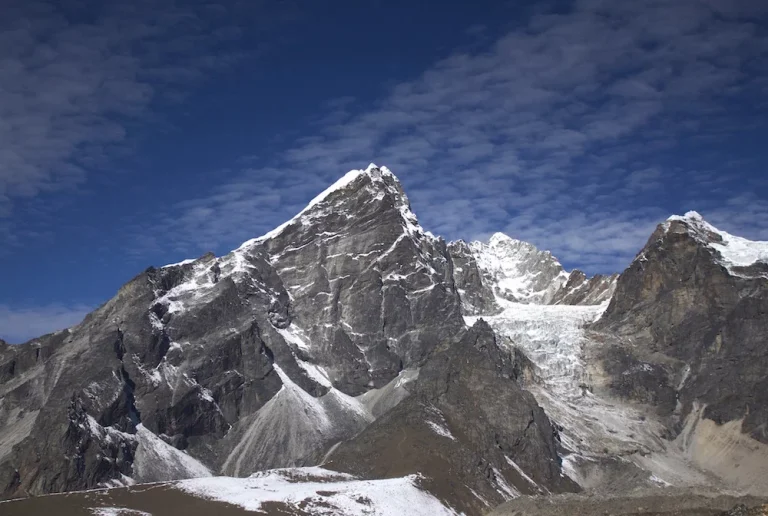
Surrounded by iconic peaks like Mount Everest, Lhotse, Nuptse, and Ama Dablam, the village itself is stark and rugged. It also lies near the Khumbu Glacier, so you can see rocky moraines, which are remnants of glaciers. A little further from the village, you may find alpine meadows with patches of grasses, high-altitude shrubs, and some wildflowers. The village and everything around it are covered in snow during the colder months. This is why only 86 locals live here permanently, according to Nepal’s 2011 National Census. Others just migrate during the peak trekking seasons to open their tea houses or lodges.
How to reach Lobuche Village from Kathmandu?
There is no direct bus, jeep, or flight that takes you to Lobuche from Kathmandu. There is still a heli service, but we are talking about a common method here. To get to Lobuche from Kathmandu, you need to first take a flight to Lukla from Kathmandu’s Tribhuvan International Airport. The flight takes about 30-40 minutes. The terminal can get really busy in peak season, causing queues and delays.

To solve this problem, you can drive to Manthali airport in Ramechhap (4-6 hours by jeep) and take a 20-minute flight to Lukla from there. From Lukla, you have to trek for 4 or 5 days on the classic EBC trek route to reach Lobuche. You enter the Sagarmatha National Park and pass through Phakding, Namche Bazaar, Tengboche, Dingboche, and Pheriche. From Pheriche, it’s a one-day trek to Lobuche.
If you want a faster and luxurious option, you can also charter a helicopter directly to Lobuche from Kathmandu or Lukla. And if you’re budget-conscious, you can enjoy an overland journey that follows the traditional route to EBC, also known as “Pioneers’ Route”. The drive takes about7-8 hours to reach Jiri and 8 to 10 hours to Salleri (both by jeep), which is the starting point of the trek. From here, the trek to Lobuche is significantly longer than the Lukla route.
On the Jiri route, you pass through remote and smaller villages like Shivalaya, Bhandar, Sete, Junbesi, Beni, Surke, and reach Phakding. Similarly, the Salleri route passes through Taksindu, Kharikhola, Paiya, Surke, and connects more directly with Phakding. The Phakding to Lobuche route is the same as the classic EBC trek route for both the Jiri and Salleri routes. The difference is in the number of trekking days. Jiri to Lobuche takes 10-12 days, whereas reaching Lobuche from Salleri is possible within 9-11 days.
Accommodation & Facilities in Lobuche
Most accomodations in Lobuche village are simple and basic teahouses and lodges. On the trek with Hillary Step treks, you’ll stay at New EBC Guest House. There are many other notable lodges, including Oxygen Altitude Home, Eco Lodge, and the National Park Hotel and Restaurant. All of them are made of stone and wood, designed to provide trekkers with warmth and safety in the harsh and remote Lobuche weather and temperature.
Rooms are usually simple, featuring twin beds with mattresses, blankets, and pillows. You should still carry a sleeping bag for added warmth. Similarly, attached bathrooms are hard to find. Toilets are often squat-style and shared at this altitude. For dining, they have a communal dining hall where you can sit with other trekkers around yak-dung stoves for warmth. Meals, however, range from traditional Sherpa staples like Shyakpa (stews), Dal Bhat to Spaghetti, Momos, and Pizza. You should book rooms in advance during peak trekking seasons. Otherwise, you will have to sleep in this same dining hall, or worse, sleep in tents.
Despite the remoteness, facilities cover most trekking needs. You can find charging stations to charge your devices. Internet access is also provided through Everest Link cards, but the connection is not really reliable. You can also enjoy hot showers, which are usually solar or gas-heated. These services cost extra. There’s also a famous bakery, “World’s Highest Bakery,” where fresh cakes, cookies, and coffee are served. Situated at 5,160m, its elevated roof offers panoramic views of Everest, Lhotse, Nuptse, and Pumori. You should stay aware of altitude sickness during your stay in Lobuche.
Climate and the Best Time to Visit Lobuche Village
Lobuche’s climate is alpine and unforgiving. You’ll face cold conditions year-round, with sharp contrasts between day and night. Autumn and spring offer the best trekking conditions. You can get the clearest views and withstand moderate weather. In summer, you have to deal with rain and slippery trails. Winter in Lobuche is brutally cold and snowbound. You can’t trek without proper gear and a flexible schedule in these off-season months.

| Season | Avg. Day Temperature | Avg. Night Temperature |
|---|---|---|
| Summer (Jun–Aug) | 5–12°C (41–54°F) | -5 to -2°C (23–28°F) |
| Autumn (Sep–Nov) | 2–10°C (36–50°F) | -10 to -5°C (14–23°F) |
| Winter (Dec–Feb) | -5 to 2°C (23–36°F) | -20 to -15°C (-4 to 5°F) |
| Spring (Mar–May) | 0–10°C (32–50°F) | -10 to -5°C (14–23°F) |
So, the best time to visit Lobuche is during autumn (late September–November). You may also trek in spring (March–May), which offers mild temperatures and rhododendron blooms in the lower valleys. However, if you trek in early March, some snow may still linger at higher altitudes.
10 Things to Do at Lobuche
While Lobuche is commonly used as a stopping point before Gorakshep for trekkers on their way to Everest Base Camp (EBC), you can do many more things here. This high-altitude village offers a variety of exciting activities, such as:
- Enjoy sunrise & sunset Views: Take a short walk up to the ridge above Lobuche or near the World’s Highest Bakery to witness stunning views of sunrise and sunset. Early morning and late afternoon light paint Everest, Lhotse, and Nuptse in golden hues, perfect for photography or simply admiring the mountain beauty.
- Hike to Lobuche Peak Base Camp: You can also do an acclimatization trek for 2 hours to Lobuche East Peak Base Camp, from where Everest, Lhotse, Nuptse, Pumori, and the Khumbu Glacier are all visible.
- Climb Lobuche East Peak: If you’re a fit and seasoned trekker with moderate mountaineering skills and proper gear, you may climb Lobuche East. It’ll take an extra 2 or 3 days, but it’ll reward you with satisfaction from both the views and the accomplishment.
- Visit the Everest Memorial at Thukla Pass: At the pass, the Everest Memorial honors climbers who lost their lives on Everest. You must not miss this spot. It’s a sobering yet moving experience that highlights the risks of high altitude mountaineering.
- Relax at the World’s Highest Bakery: This bakery is famous for fresh cakes, cookies, bread, and hot drinks. Spend time here relaxing, meeting other trekkers, and enjoying the Himalayas from an elevation of 5,160m.
- Explore the Khumbu Glacier: After walking along the Khumbu Glacier, you can witness dramatic ice formations and deep crevasses. Later, the towering Khumbu Icefall also comes into view with Everest, Lhotse, and Makalu in the backdrop.
- Short Trek to Chukkhung Valley: Chukkhung is a small village located a little lower than Lobuche. From here, you can enjoy views of the Island Peak and Lhotse Shar after a hike of 7-9 hours.
- Discover nearby spots: Explore small Sherpa settlements, mani walls, and prayer flags around Lobuche. If you go lower toward Dingboche or Pheriche, you can find high-altitude Imja Tsho (Lake) and Himalayan streams.
- Connect with Sherpa Culture: You should spend some time talking to locals and tasting their traditional butter tea (Po Cha). You’ll gain precious insights into the well-known Sherpa life, spirituality, and their mountaineering heritage.
- Rest & Acclimatize for the final push to EBC: Prepare for the trek to Everest Base Camp, located just one village away (Gorakshep). Take time to rest, enjoy the views, and let your body adjust to the altitude.