


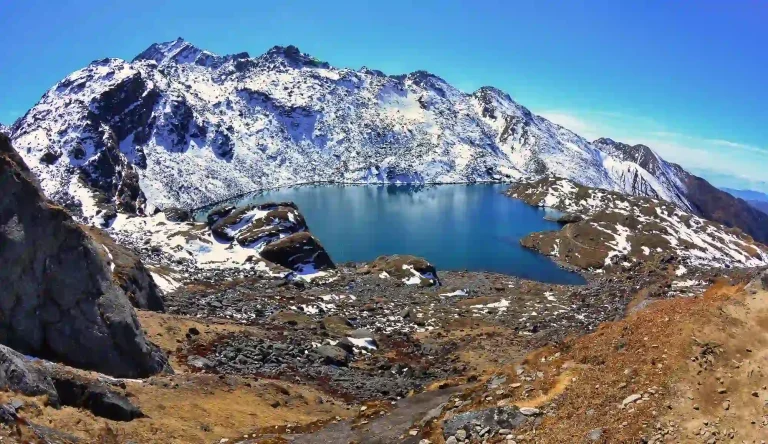
Gosaikunda is a sacred freshwater lake at an elevation of 4,380m (14,370ft) inside Langtang National Park, Rasuwa District. This high-altitude glacial lake spans about 13.8 hectares and is both a major Hindu pilgrimage site and one of the most popular trek destinations in Nepal, offering wide mountain views across the Langtang range.
The Unique Appeal of Gosaikunda
Most classic Nepal treks take two to three weeks with a long itinerary, but Gosaikunda manages to give you the same high-altitude scenery in under a week. You climb 2,350m from Dhunche (2,030m) to the sacred lake (4,380m) in just a couple of days. Yeah, it’s steep, but it’s totally doable if you’re reasonably fit. The best part? You get to reach the heart of the Himalayas and soak in sweeping views of Langtang, Ganesh Himal, and Manaslu without taking weeks off.
Additionally, the scenery shifts dramatically with the seasons. In winter, the lake freezes into a sacred ice basin where pilgrims worship the natural ice Shiva Lingams. During spring, the hillsides burst with pink and crimson rhododendron blooms, while autumn brings crystal-clear skies for the best mountain views. Thus, every season offers a fresh perspective on the same incredible alpine landscape.
Furthermore, the trek to Gosaikunda isn’t just about one lake. You actually trek in a network of 108 alpine lakes, including Saraswati Kunda, Bhairav Kunda, and Surya Kunda, all easily accessible from the main lake. This means you can explore multiple sacred sites in a single day. Hence, this combination of culture, spirituality, and jaw-dropping scenery is what truly makes Gosaikunda a one-of-a-kind Himalayan trek.
Where Exactly Is Gosaikunda?
It is situated at 28.0833° N, 85.4167° E in Rasuwa District, Bagmati Province, in central Nepal. Nestled in the north-central Himalayas, it lies about 67.5km (42mi) straight north of Kathmandu and roughly 140km by road and trail. The lake rests just south of the Langtang Himal range and northeast of Dhunche, the district’s administrative center.
It remains within the protected area of Langtang National Park, bordered by the Helambu region to the south and the Langtang Valley to the north. Lauribina La Pass (4,610 m) marks its edge and serves as an important landmark for anyone trekking between the Gosaikunda and Helambu valleys.
The Story Behind the Sacred Lake
According to Hindu mythology, Gosaikunda Lake was created during the Samudra Manthan, the cosmic churning of the ocean. It is believed that a deadly poison rose from the depths, and Lord Shiva drank it to protect the universe. The poison burned his throat and turned it blue. To cool the intense heat, he traveled to the high Himalayas and struck the mountain with his Trishul, releasing three streams of pure water that formed Gosaikunda. Shiva drank and bathed in this sacred lake, which is why he is known as Neelkantha.
Today, the lake stands as one of Nepal’s holiest pilgrimage sites, especially during Janai Purnima in August. Thousands of devotees make the difficult ascent to bathe in the icy water. It is believed to purify the soul and strengthen one’s connection to Lord Shiva. The entire area is transformed into a powerful spiritual arena where Hindu men renew their Janai (sacred thread) and Jhankris (shamans), from across Nepal, gather to perform rituals, rhythmic dances, and healing ceremonies.
The atmosphere during the pilgrimage season is vastly different from the peaceful trekking months. The trails burst with energy as crowds chant “Jai Shambho,” shamanic drums echo through the valleys, and long lines of pilgrims climb toward the lake despite slippery monsoon paths. At this time, accommodation becomes limited, and the journey gets tougher. However, the cultural immersion is unmatched. It’s a rare moment when the physical challenge of the high-altitude climb blends seamlessly with devotion, tradition, and collective faith.
Culture on the Trail
You experience a strong mix of Tamang culture on the Gosaikunda trekking route. The villages along the way follow Tibeto-Burman traditions and Vajrayana Buddhism. You see stone houses with carved wooden windows, terraced fields, and daily routines shaped by the mountain seasons. When you pass through places like Dhunche and Thulo Syabru, locals often welcome you with warm hospitality, share Su-Chya (butter tea), and talk about life in the highlands.
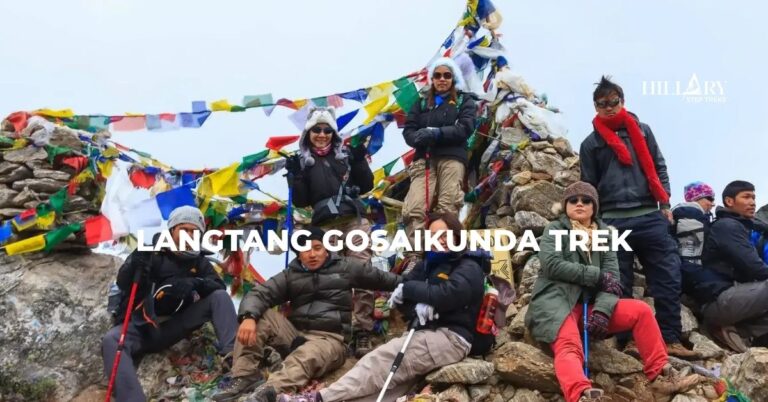
As you move higher, you walk past chortens, mani walls with carved mantras, and small shrines. When you reach the lake, the main highlight is the Gosaikunda Temple, where pilgrims offer prayers to Lord Shiva. The lake’s edge is filled with colorful prayer flags that represent the five elements and are believed to carry prayers with the wind.
While trekking, you should walk clockwise around the shrines and the lake. Other than that, dress modestly, take off your shoes before entering temple areas, and avoid touching offerings. Always ask before taking photos of locals or rituals, and keep the area clean to respect the holy site.
The Natural Side of Gosaikunda Lakes Trek
As you walk into the Gosaikunda region inside Langtang National Park, you feel the biodiversity change with every hour you climb. The lower trails pull you through thick forests of oak, maple, and rhododendron, those bright red and pink flowers Nepal is famous for. Higher up, the trees shift intolarch and Himalayan fir. This is where you might get lucky and spot a red panda slipping through the branches or see Himalayan Tahr and musk deer moving quietly through the woods. Once you push beyond 4,000m, all that lushness fades into tough little alpine shrubs, mosses, and medicinal herbs hanging on for dear life against the cold.
The landscape also flips on you in the most dramatic way. You start in warm, subtropical river valleys and terraced hillsides, walking through forests so old and mossy. But once you reach the Lauribina ridge, the whole mood changes. Suddenly, you’re in this huge, open alpine terrain where the greens disappear. You only see gray rock, scree, and sharp mountain edges.
Then, at the high-altitude plateau full of glacial lakes, Gosaikunda becomes the star. You also see Saraswati Kunda, Bhairab Kunda, Surya Kunda, and others scattered across the basin like blue jewels. They’re fed by glaciers and stay frozen for half the year. When they melt, the deep turquoise water against the snow-covered Langtang peaks looks unreal, honestly, one of the most striking alpine views you’ll ever see.
From Pine Forests to Rocky High Pass during Gosaikunda Trail
When you start the trek from Dhunche to Chandanbari(also called Sing Gompa), you’re basically walking into a tunnel of green. The trail pulls you through forests of oak, hemlock, and blooming rhododendrons, with terraced fields and tiny villages giving you quick snapshots of daily life in Rasuwa. The climb is steady, just a long, gradual push through cool, mossy woods where you can hear streams rushing and birds calling. This lower part feels calm and breathable, easing you into the harder sections ahead.
But once you walk past Chandanbari, the whole vibe changes. The trail starts with a steep climb through stone stair-like sections that make your lungs work overtime. The trees thin out fast, and by the time you reach the ridges around Lauribina (3,910m), everything is open, windy, and dramatic. The views of Ganesh Himal and Manaslu are breathtaking, but the exposed slopes and narrow pathways definitely keep you alert. One misstep and you’re humbled real quick.
Then, the final stretch toward Gosaikunda feels almost unreal. The trail turns into a rocky maze of scree, boulders, and patches of stubborn snow that stick around until spring. The air is thin, and you pass smaller lakes like Saraswati and Bhairab Kunda before the main lake finally appears at 4,380m. The walk to Lauribina La Pass (4,610m) gets even tougher, snow-covered, windy, and demanding full focus. Once you cross the pass and make your way past Tharepati and Melamchi Gaon, the harsh, rocky highlands fade away, and you once again drop into Nepal’s famous green Hills.
How to Reach Gosaikunda?
Before you start the trek to the lake of Gosaikunda, you need to obtain a Langtang National Park Entry Permit and a TIMS card.If you start from Sundarijal in the Helambu region, you will need an additional Shivapuri-Nagarjun National Park Permit. It’s best to arrange these in Kathmandu before leaving, usually through your trekking agency, which also helps with a licensed guide, ensuring you start your trek on time and smoothly.
| Permit Type | Required For | Cost | Where to Get | Notes |
|---|---|---|---|---|
| Langtang National Park Entry Permit | Any Gosaikunda trekker | NPR 3,000 + 13% VAT (foreigners) / NPR 1,500 + VAT (SAARC) | NTB Kathmandu or Dhunche checkpoint | Mandatory because Gosaikunda sits inside Langtang NP |
| TIMS Card | All trekkers | NPR 2,000 (foreigners) / NPR 600 (SAARC) | NTB Kathmandu or trekking agency | Registers your trekking route for safety |
| Shivapuri-Nagarjun National Park Entry Permit | Only if starting from Sundarijal | NPR 1,000 (foreigners) / NPR 600 (SAARC) | Sundarijal Gate or NTB Kathmandu | Needed before entering the Helambu trail section |
After you have your permits, the trek officially begins. Most trekkers leave Kathmandu early in the morning. The Dhunche route is the fastest and most popular. It takes you directly toward Chandanbari and Lauribina with sweeping Himalayan views. Alternatively, you can trek from Sundarijal on the Helambu route. It is a quieter, forested approach with gentler altitude gain.
And if you have time for a longer, more immersive experience, you can start from Syabrubesi or Dhunche for a Langtang Gosaikunda Trek. This way, you can enjoy a mix of villages, high ridges, and sacred lakes over just 13 days.
Starting Point of Gosaikunda from Dhunche
Dhunche is the primary roadhead and administrative center of Rasuwa District, making it the most common and direct starting point for trekkers heading to Gosaikunda. It sits at about 2,030m (6,660 ft) and spreads along the Trishuli River gorge, surrounded by terraced hills and pine forests. The drive from Kathmandu covers roughly 140km and takes 6-8 hours by bus or private jeep, depending on road conditions and traffic.
As the last major settlement before entering Langtang National Park, Dhunche is vital for preparation. You’ll find lodges and teahouses offering hot meals and showers, and shops stocking essentials like water, snacks, and basic trekking gear. This is also where your Langtang National Park entry permit and TIMS card are officially checked at the NTB counter.
The trek begins almost immediately after leaving Dhunche. You start climbing toward Deurali and Chandanbari. For in-and-out itineraries, Dhunche serves as both the starting and ending point.
Gosaikunda Trek Difficulty
The Gosaikunda Trek is considered moderate to challenging. Even though the distance is shorter than the Everest or Annapurna circuits, the trail is tough due to steep, continuous climbs and rapid altitude gain. You’ll trek from 2,030m at Dhunche to 4,380m at the lake in just two to three days.
Therefore, you need good cardiovascular fitness and should be comfortable hiking 5-7 hours a day on steep stone stairs and rocky paths while carrying a daypack. Prior experience at high altitudes will help because you’ll know how your body reacts to thinner air. Mentally, you need resilience to handle basic teahouse stays, unpredictable weather, and long, vertical climbs.
Gosaikunda Altitude Profile
The Gosaikunda Trek has one of the steepest altitude profiles in Nepal. You typically climb over 2,300m (7,500ft) in just 2 to 3 days, which is much faster than the recommended rate for high-altitude acclimatization. This makes pacing and careful planning essential to avoid altitude sickness.
| Location | Elevation (Meters / Feet) |
|---|---|
| Kathmandu | 1,400m / 4,593ft |
| Dhunche | 2,030m / 6,660ft |
| Chandanbari | 3,330m / 10,925ft |
| Lauribina | 3,910m / 12,828ft |
| Gosaikunda | 4,380m / 14,370ft |
| Lauribina La Pass | 4,610m / 15,125ft |
Because the trek covers such a large altitude gain in a short time, Acute Mountain Sickness (AMS) is the biggest risk. Symptoms can include headaches, nausea, dizziness, and loss of appetite. If you ignore these and continue, serious conditions like HAPE or HACE can develop, especially if you’re a beginner trekker.
How to Stay Safe and Acclimatize on Gosaikunda Trek
To manage the difficulty and prevent altitude sickness-related issues on the Gosaikunda trek, follow the few key strategies below:
- Add acclimatization days at Chandanbari (3,330m) or Lauribina (3,910m) to adjust to high altitude.
- Limit daily elevation gain to 500-600m once you’re above 3,000m.
- Walk at a steady, conversational pace to avoid overexertion.
- Drink 3-4 liters of water daily to stay properly hydrated.
- Hire a porter to carry your pack. This reduces physical strain and allows you to focus on breathing and footing on steep sections.
Gosaikunda Weather and Seasons
Gosaikunda’s high-altitude setting creates dramatic seasonal changes, with the lake staying frozen for almost half the year. Knowing these cycles is key to safety and planning your trek.
| Season | Months | Day/Night Temperature | Trail Conditions |
|---|---|---|---|
| Spring | March – May | 10°C to -5°C | Best for flora, rhododendrons bloom, and some lingering snow at the lake |
| Autumn | Sept – Nov | 12°C to -10°C | Peak season, clear skies, crisp views; stable weather |
| Winter | Dec – Feb | 5°C to -20°C | Deep snow, frozen lakes, many lodges closed, high risk of pass closure |
| Monsoon | June – Aug | 15°C to 5°C | Heavy rain, leeches, cloudy views, active pilgrimage season |
Thus, spring and autumn are the ideal times to visit. Autumn gives the most stable weather and the sharpest mountain views, while spring offers the contrast of white peaks against vibrant rhododendron forests. Monsoon sees thousands of pilgrims, but slippery trails, leeches, and cloudy skies make it less ideal if you’re a leisure trekker.
Winter at Gosaikunda
Winter (December to February) trekking in Nepal is something entirely otherworldly. The lake freezes into a solid sheet of ice, and ridges are blanketed in snow. The crowds vanish, leaving near-complete solitude under brilliant blue skies. But it’s not easy when temperatures drop below -15°C. Steep sections around Lauribina and Lauribina La Pass can be impassable without technical gear.
Additionally, many teahouses close during this time. So, only experienced trekkers with professional guides, top-quality cold-weather gear, and tools like crampons or micro-spikes should attempt winter trekking. You also need a flexible itinerary for winter month trekking in case of weather delays.
Trekking to Gosaikunda
Classic Gosaikunda Trek Itinerary from Dhunche
Our Gosaikunda Trek is a 5-day adventure to the sacred alpine lake at 4,380 meters in Langtang National Park, perfect for trekkers with limited time who want stunning mountain views and a deep cultural experience.
Full Itinerary Outline
Day 1: Kathmandu to Dhunche
- Drive 6-7 hours along the Trishuli River to Dhunche
Day 2: Dhunche to Chandanbari/Sing Gompa
- Trek 6-7 hours via Deurali and Dimsa villages
Day 3: Chandanbari to Gosaikunda
- Trek 6-7 hours to Gosaikunda Lake (4,380m) via Lauribinayak
Day 4: Gosaikunda to Dhunche
- Descend 7-8 hours back to Dhunche
Day 5: Dhunche to Kathmandu
- Drive 6-7 hours back to Kathmandu
Langtang Gosaikunda Lakes Trek
Our Langtang Gosaikunda Trek is a 13-day journey combining the Langtang Valley with the sacred Gosaikunda lakes. It includes a challenging Lauribina Pass at 4,610m. The route starts from Syabrubesi, then you exploreKyanjin Gompa and Thulo Syabru, before trekking to Chandanbari. From there, you cross the pass and descend through Gopte and Chisapani back to Kathmandu, with an acclimatization day at Kyanjin.
This trek is ideal for photographers seeking varied landscapes, repeat visitors seeking a quieter alternative to Everest or Annapurna treks, and trekkers who want better acclimatization through gradual altitude gain. It combines cultural insights into Tamang villages and monasteries with high-altitude natural beauty, making it a balanced, immersive experience.
Full Itinerary Outline
Day 1: Kathmandu to Syabrubesi
- Drive 7-8 hours to Syabrubesi via scenic landscapes
Day 2: Syabrubesi to Lama Hotel
- Trek through rhododendron forests and villages (Mundu, Gumna Chowk)
Day 3: Lama Hotel to Langtang Village
- Ascend through oak and hemlock forests, passing Ghode Tabela and Thyangsyap
Day 4: Langtang Village to Kyanjin
- Visit the largest mani wall and the Kyanjin Gompa monastery
Day 5: Acclimatization Day at Kyanjin
- Rest day with optional hikes to Tsergo Ri, Kyanjin Ri, or Langshisha Kharka
Day 6: Kyanjin to Lama Hotel
- Descend through alpine meadows back to Lama Hotel
Day 7: Lama Hotel to Thulo Syabru
- Descend to Pairo, then ascend to Thulo Syabru village
Day 8: Thulo Syabru to Cholangpati
- Climb through forests, passing Shin Gompa and the cheese factory
Day 9: Cholangpati to Gosaikunda
- Trek to sacred Gosaikunda Lake (4,380m) via Lauribina
Day 10: Gosaikunda to Gopte
- Cross Lauribina Pass (4,610m) and descend to Gopte
Day 11: Gopte to Kutumsang
- Descend through forests, passing Magin Goth
Day 12: Kutumsang to Chisapani
- Trek through settlements with mountain views
Day 13: Chisapani to Kathmandu
- Trek to Sundarijal, then drive back to Kathmandu
Minimizing Impact Around a Sacred Lake
Gosaikunda is both a fragile alpine ecosystem and a sacred spiritual site. Therefore, it is very important to follow responsible travel practices to preserve the environment and sanctity. Some of them are:
- Avoid washing clothes or using soap in the lake.
- Walk clockwise around religious structures like Chortens and Mani walls.
- Keep your tone respectful and dress modestly.
- Always ask before photographing devotees or taking pictures inside shrines.
- Pack out all waste. Do not leave any snack wrappers, cigarette butts, or tissues on the trail.
- Use refillable water bottles and treat water instead of relying on single-use plastics.
- Stay on marked trails to prevent soil erosion in sensitive alpine meadows.
- Support the local community by hiring local guides and porters, staying in local teahouses, and eating locally sourced meals.
- Purchase handicrafts to provide income to families in the park and encourage the protection of Gosaikunda’s natural and cultural heritage.
Ready to Trek to Gosaikunda? Plan Your High-Altitude Lake Adventure
The Gosaikunda route is one of Nepal’s most unforgettable treks. You trek from lush lower valleys up to the holy lake at 4,380m, passing by charming Tamang villages, rhododendron forests, and panoramic views of Langtang, Ganesh Himal, and Manaslu. You can choose a short 5-day trek directly to the lake or a longer 13-day journey that combines the Langtang Valley and Gosaikunda lakes, including the challenging Lauribina La Pass.
Explore both our Gosaikunda trek itineraries and discover the route that’s perfect for you!


