


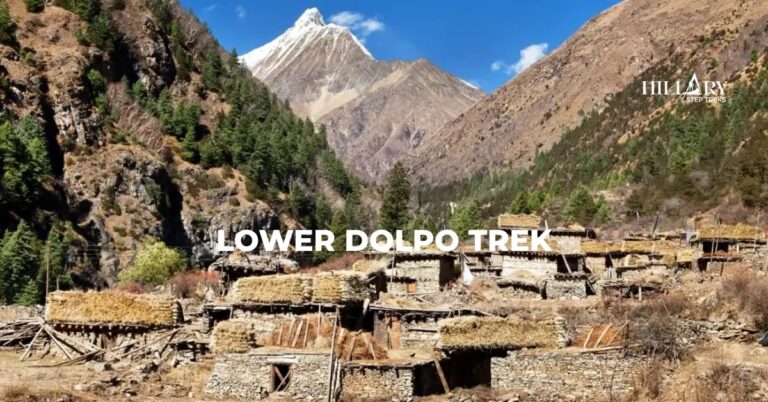
Numa La (5,309m) and Baga La (5,169m) are the two major passes on the remote, high-altitude Lower Dolpo Circuit. These passes are more than steep climbs through the Shey Phoksundo National Park. They mark the shift from the dry, ancient villages of Dho Tarap to the quiet alpine world around Phoksundo Lake. You cross them one after the other, which is the toughest part of the trek, demanding strength and focus. But don’t let that intimidate you. The effort rewards you with sweeping views of the Dhaulagiri massif and a rare, unfiltered glimpse into Nepal’s remote, hidden land.
Numa La Pass
Standing at 5,309m, Numa La is the highest point of the Lower Dolpo Trek. Its name reflects the landscape’s shape. In Tibetan, “Numa” translates to “like a woman’s breast,” describing the rounded forms of the surrounding hills. Still, there’s nothing soft about the climb. The ascent pushes steadily through a dry, high-altitude desert where greenery fades away, replaced by loose scree and old glacial moraine.
At the top, the pass narrows into a wind-beaten saddle lined with faded prayer flags. From here, the view opens wide: Dhaulagiri rises powerfully to the south, while the sharp, lesser-known peaks of the Kanjirowa Himal stretch across the northern skyline. This is the core of Shey Phoksundo National Park, a rain-shadow wilderness where silence dominates, broken only by the call of a Himalayan griffon or the distant movement of blue sheep.
Baga La Pass
While Numa La is the highest point of the trek, Baga La Pass (5,169m) is the one that turns the Lower Dolpo Trek more intense and dramatic. It is the second big high-altitude hurdle and a dramatic doorway between two worlds. “Baga” in the local dialect means a “round opening” or “notch,” named after how it slices through the jagged ridgeline. The slopes are rich in minerals, giving them striking ochre, purple, and red hues. Together, they form a high-altitude desert that provides habitat for Himalayan blue sheep and the elusive snow leopard.
Historically, the pass is a vital trade route for the Dolpa-pa, whose yak and mule caravans still cross it with essential goods. Unlike Numa La’s broad, rolling ridges, Baga La is sharper and more vertical. You can get a direct view of the Kanjirowa Himal massif from its summit, marked with prayer flags and stone cairns. From this point on, the arid, Tibetan-influenced landscape ends entirely, and the steep descent into the lush Shey Phoksundo Lake basin begins.
Why Baga La & Numa La Define the Lower Dolpo Trek?
Numa La and Baga La passes are important stages of the Lower Dolpo Trek itinerary. They sit at the edge of the Himalayan rain shadow, taking you between two starkly contrasting landscapes: the arid, Tibetan-style plateau of the Dho Tarap and the lush, moisture-rich alpine basins of the Phoksundo region. You cross them back-to-back, which is not easy. It is a test of both altitude and endurance. The climb tires every muscle, and the quick shift from barren desert to lush alpine forest hits like a punch, making the contrasts of the trek impossible to ignore. Thus, these two high points are boundaries that mark the limits of human and ecological survival in the remote Dolpo region of western Nepal.
Beyond their physical challenge, Numa La and Baga La act as cultural bridges between two ancient worlds. These passes are more than physical barriers, they are sacred spaces where the human world meets the realm of mountain deities. For the Dolpo-pa people, crossing them is a ritual, marked by hanging Buddhist and Bon-Po prayer flags and building stone cairns(lhatse) to bless their salt-trading caravans. Hence, trekking to these heights is a walk on an ancestral high highway that has remained unchanged for centuries. The passes shape the journey, forcing you to move at the rhythm of local culture, slow, deliberate, and deeply respectful of the spirits guarding these 5,000-meter gateways.
Comparing Numa La vs Baga La Pass
While both passes come back-to-back in the Lower Dolpo Circuit trek, they test trekkers in very different ways. Numa La is the endurance pass, the highest point of the trek that pushes your lungs and legs to their limits in the thin air. On the other hand, Baga La is the technical challenge, famous for its steep, knee-busting descent and the dramatic shift in scenery as you leave the rain-shadow desert and enter the lush Phoksundo basin.
Here’s a breakdown of what makes each pass unique, so you can prepare for their specific demands:
| Feature | Numa La Pass | Baga La Pass |
|---|---|---|
| Elevation | 5,309m (17,418 ft) | 5,169m (16,958 ft) |
| Primary Challenge | High altitude & thin oxygen | Steep, technical descent & loose scree |
| Terrain Style | Broad, rolling moraine & high-desert plateau | Narrow notch & sharp, vertical canyon walls |
| Visual Highlight | 360° panorama of the Dhaulagiri Massif | Close-up of Kanjirowa Himal & Phoksundo Lake |
| Climatic Zone | Deep Trans-Himalayan rain shadow | Transition from arid desert to alpine forest |
| Meaning of Name | Woman’s Breast because of its rounded slopes | Round Opening or The Notch |
| Strategic Role | The Apex: The maximum altitude reached | The Pivot: The descent into the lake basin |
| Gear Priority | Insulation: Maximum thermal layers for the highest, coldest point | Stability: Trekking poles & gaiters for the 1,500m scree descent |
Crossing Two High Passes in Consecutive Days
Crossing Numa La and Baga La in quick succession is one of the toughest challenges in the Himalayas, often harder than a single high-altitude pass like Thorong La or Cho La. With no low-altitude break between these two 5,000-meter giants, the trek pushes your heart and lungs to their limits under sustained thin air. This relentless stretch turns the Lower Dolpo Trek into a true endurance test, creating a combined physical and mental strain that shapes every step, decision, and aspect of your stamina and safety.
Physical and Physiological Impact
- Double-Summit Fatigue: Most high-altitude treks give you a valley descent or rest day after a 5,000m peak. But here, you stay above 4,400m between the two passes. Thus, your body needs to withstand high-altitude stress for over 48 hours with no chance to recover.
- Oxygen Deprivation (Hypoxia): At these elevations, oxygen levels are roughly half of sea level. Crossing two peaks in 1-2 days pushes your heart and lungs to the limit, with almost no time for your body to produce new red blood cells.
- Muscle and Joint Strain: The effort is not only internal. You must navigate thousands of vertical meters on unstable moraine and shifting scree. With muscles already exhausted from the strenuous Numa La pass, every step on Baga La’s steep descent becomes more dangerous.
 USD 300 OFF
Logistical and Mental Impact
- Point of No Return Isolation: Between the passes, you are in one of the most remote sections of the Lower Dolpo region. There are no teahouses and no electricity beyond Numa La Base Camp till Yak Kharka, thus, no easy escape. Hence, you have to rely entirely on your own preparation, your camping crew, and mental grit to keep moving.
- Weather Vulnerability: Consecutive crossings double your exposure to high-altitude weather. A sudden storm or snowfall on day one can turn day two’s approach to Baga La into a slippery, low-visibility hazard. This increases both the challenge and risk, turning your trekking experience far more demanding and unpredictable.
Oxygen Availability & Altitude Physiology on Numa La Pass and Baga La
As you move between Numa La Base Camp (4,440m) and Danigar (4,631m), the atmospheric pressure drops significantly, leaving you with only58-60% of the effective oxygenfound at sea level. Your body responds to this hypoxia immediately. Breathing deepens and speeds up even while resting, and your heart beats faster to pump oxygen through the system.
After you reach the mid-sections between 4,800m and 5,100m, oxygen levels drop further toward 54%,and the body begins producing extra red blood cells to compensate, a process called polycythemia. The blood thickens, muscles tire faster, and your cardiovascular system is under constant strain. On the steep moraine and scree, every step becomes a conscious effort, and even your mind feels the impact as your body battles sustained hypoxia.
By the time you reach the summits of Numa La and Baga La, oxygen levels fall to roughly 51-53%, and the air feels noticeably thin. Each breath delivers only half the oxygen your muscles and brain are used to, forcing your body to work at full capacity just to stay functional. With no low-altitude recovery between high camps and summits, the cumulative oxygen debt defines the trek’s challenge, making the passage between these two giants a true test of endurance, focus, and high-altitude survival.
Conclusion
The ascent to Numa La and Baga La is the biggest challenge on the Lower Dolpo Circuit, combining physical endurance with incredible scenery. These passes are more than obstacles, they show the dramatic change from the dry, rain-shadow deserts of the north to the green, alpine basin around Phoksundo Lake. The climb is tough, but the reward is amazing: clear, wide views of the Dhaulagiri and Kanjirowa ranges that only a few travelers see.
This section demands careful pacing, respect for the altitude, and full self-sufficiency. Every step tests your body and mind, from the thin air of Numa La to the steep descent of Baga La. Reaching the summits gives a real sense of isolation and connection to the untouched Himalaya. These passes are the guardians of Dolpo that protect one of the most special cultural and natural landscapes in Nepal.
Ready to push your limits against Nepal’s high-altitude passes? Plan your Lower Dolpo camping trek with our experts’ support to take on Numa La and Baga La.


