If you are planning an Annapurna Base Camp Trek and looking for a complete guide before heading out, you are in the right place. Trekking enthusiasts worldwide might have heard about Nepal for its incredible trekking destinations, such as Annapurna Base Camp. The country has other trekking destinations, such as Everest Base Camp, Annapurna Circuit Trek, and Langtang Valley Trek.
Among these many awesome treks in Nepal, the trek to ABC successfully creates its place in the hearts of the trekkers with its unique trekking trails. Distinct from other trekking destinations, the Annapurna Base Camp trekking trails are mostly covered with diverse landscapes with unique flora and fauna. The trekking time is shorter, too, making it perfect for those looking to relish the astonishing Himalayas but are time-bound.
If you are also looking forward to picking Annapurna Base Camp as your trekking destination and immersing yourself in astonishing nature, then you have landed on the right page. This article presents you with the Annapurna Base Camp Trek Guide, which covers everything you need to know before embarking on your expedition.
Table of Contents
Where Is Annapurna Base Camp?
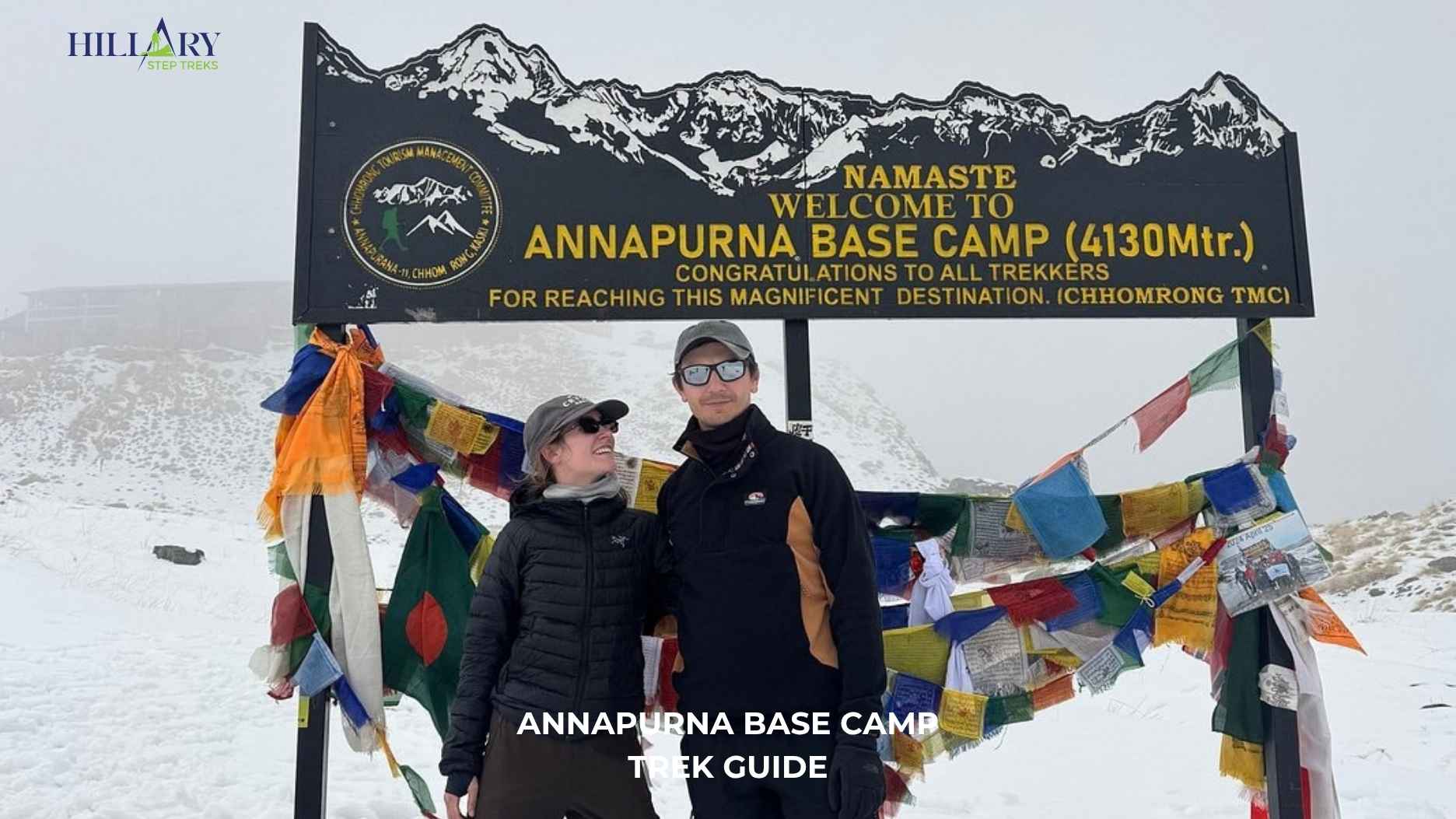
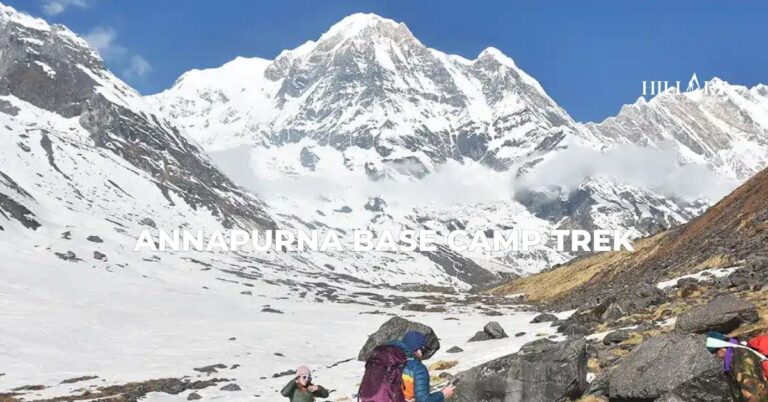
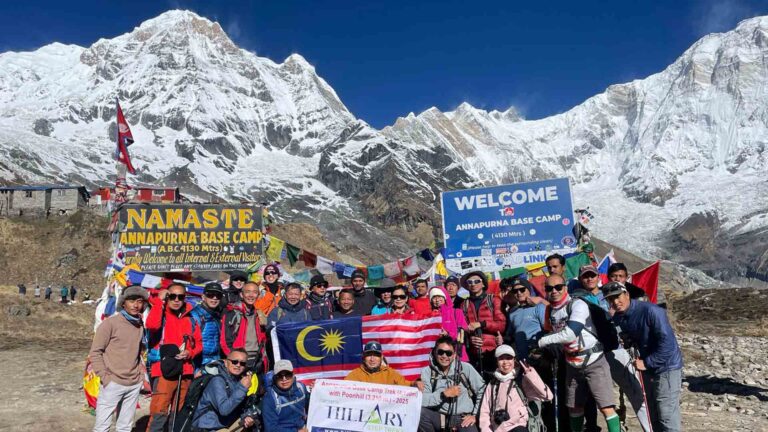
Annapurna Base Camp (ABC) is located in the Annapurna Sanctuary of the Annapurna region in north-central Nepal, at an elevation of 4,130 meters (13,550 feet). The base camp sits within a natural mountain amphitheater surrounded by some of the highest peaks in the Annapurna range, including Annapurna I, Annapurna South, Hiunchuli, Machhapuchhre (Fishtail), and Gangapurna.

The usual Annapurna Base Camp trekking route begins from Pokhara, with the trail passing through Syauli Bazaar, Ghandruk, Chhomrong, Sinuwa, Bamboo, Dovan, Himalaya, Deurali, and Machhapuchhre Base Camp before reaching ABC. On the 7-day itinerary offered by Hillary Step Trek, trekkers drive from Pokhara to Syauli Bazaar, trek through Ghandruk and the Modi Khola valley, and reach Annapurna Base Camp on the fourth trekking day.
The location is particularly notable because the trail changes considerably as it approaches the sanctuary. Lower sections pass through villages, terraced landscapes, and rhododendron forests, while the higher section leads into a more alpine environment with rocky terrain, glaciers, and snow-covered peaks. From ABC, trekkers get close-up views of the surrounding Annapurna massif and Machhapuchhre.
How Difficult Is the Annapurna Base Camp Trek?
The Annapurna Base Camp Trek is a moderate trek suitable for travelers with a reasonable level of fitness. The trail involves several hours of walking each day, with steep stone steps, uneven paths, and repeated uphill and downhill sections. The highest point is Annapurna Base Camp at 4,130 meters (13,550 feet).
The most challenging section is the climb from Deurali toward Machhapuchhre Base Camp and Annapurna Base Camp. Previous high-altitude trekking experience is not essential, but regular walking, stair climbing, and uphill training before the trek can make the journey more comfortable.
Physical Fitness
On each trekking day, you will walk for several hours with steep ascents and descents. Therefore, Annapurna Base camp trekking requires you to have a good level of fitness. We encourage you to work on your fitness for 12 to 16 weeks before you embark on the trekking trails. Physical activities such as jogging, hiking, cycling, or swimming can achieve physical fitness during trekking. In addition, cardio exercises can help you increase your stamina and achieve muscle endurance. So, give time for those activities; it will make your trek much easier.
Mentally Preparation for Trek
Along with physical fitness, you must also be mentally prepared for the trek. Sometimes anxiety and fear can take over and ruin your fun. So the best way to prepare mentally is to know about the trek. You can research the trek, its difficulty, foods, and accommodation for the trek, and more. Furthermore, you can also take meditation, yoga, or breathing classes so that you’ll have an easy time breathing at a high altitude.
Is a Guide Required for ABC?
Yes, a licensed guide is required for foreign trekkers doing the Annapurna Base Camp Trek under Nepal’s trekking regulations introduced on April 1, 2023. Hillary Step Trek’s ABC package includes a professional, government-licensed English-speaking trekking guide, along with guide support for navigation, permits, accommodation, and day-to-day trek arrangements.
Having a guide is also useful on the ABC route because the trek involves steep sections, changing terrain, and high-altitude areas up to 4,130 meters at Annapurna Base Camp. A guide can help you stay on the correct trail, manage the daily pace, coordinate with teahouses, and respond appropriately if altitude-related problems or other difficulties occur.
Annapurna Base Camp Altitude and Acclimatization
While trekking around the ABC region, you must first know about Altitude sickness. Trekkers who do not know about altitude sickness are most prone to it. During your trek to the Annapurna range, you will reach an altitude of over 4130m. The chances of Altitude sickness increase at a height above 3000m.
As you climb the altitude, the oxygen level and the air pressure are lower. The lower air pressure and oxygen level start reacting with the body, weakening it. If you suffer from Altitude sickness, you will feel symptoms like headache, fever, nausea, vomiting, dizziness, and fatigue.
There are a few types of Altitude Sickness, like Acute Mountain Sickness, High Altitude Pulmonary Edema (HAPE), and High Altitude Cerebral Edema (HACE). One easy preventive measure for Altitude sickness is climbing altitude slowly and acclimatizing. When you rush toward high altitude, your body cannot adjust to the lower oxygen levels. So, you must climb altitude gradually.
This way, you can acclimatize to the climate and altitude. There are a few ways to acclimatize during your trek, and they are:
Climb High, Sleep Low: One of the best and most appropriate ways of acclimatization is to climb high and sleep low. While trekking in the ABC region, you will reach above 4000m, but it is always wise to descend and sleep at a lower altitude.
Be Patient: During your trek to ABC, patience is a virtue. There is no point rushing to the top. Be patient. Take a break whenever you can so you won’t be fatigued and get used to the climate and surroundings.
Stay Hydrated: Drinking plenty of fluids is important to acclimate. Aim for 3-4 liters of water daily. Electrolyte-rich drinks can also help replace lost salts and minerals. It’s best to use simple and familiar words.
Safety precautions
As mentioned earlier, trekking in the high Himalayan region involves a certain degree of risk. Therefore, it becomes important to consider the safety precautions before commencing the journey on Annapurna Base Camp trekking. To ensure a safe journey, here are some useful tips to consider.
- Always choose a licensed guide and a porter. They will not only help you stay safe but also eliminate and manage the consequences of unfortunate incidents.
- Make sure to stay hydrated. This will help you keep your body energized. Also, it is key to preventing altitude sickness.
- Always follow a healthy and balanced diet to avoid the risks of sickness and illness.
- Do not rush on trekking trails. Make sure to acclimatize properly before ascending to higher altitudes.
Best Time to do the Annapurna Base Camp trek

While the Annapurna Base camp trek is open for all months in a year, there certainly is a time of the year, when you make the most of your trek. In particular, Autumn (September to November) and spring seasons (March to May) are considered the best times to do the Annapurna base camp trek.
In the spring, wildflowers bloom to add beauty to your trekking trails. Vibrant flowers welcome you all around. The temperatures are also mild and pleasant, making trekking comfortable.
Autumn is considered the best time of the year for the ABC trek, and the trekking route is usually busy. This season is perfect for scenic views and climate conditions. The skies are usually clear with dry weather, presenting stunning views of the region’s sky-touching mountains.
Some trekkers also prefer to travel in the winter to see the mesmerizing glacial view of the Annapurna region. However, they recommend avoiding the monsoon season due to relentless rain, leeches, and insects, as well as the chance of natural disasters.
However, the best seasons also mean the busiest seasons. Therefore, you can expect the trekking trails to be crowded. Be ready for it.
What Is the Weather Like at Annapurna Base Camp?
Weather at Annapurna Base Camp varies significantly with altitude and season. The trek reaches 4,130 meters, so temperatures are much colder around base camp than in lower villages such as Ghandruk and Sinuwa. During spring and autumn, the days are generally comfortable for trekking, with clearer skies and relatively stable conditions, while mornings and nights at ABC can be below freezing. The route also passes through changing landscapes, from warm, forested areas to snowy and glacial terrain near Machhapuchhre Base Camp and Annapurna Base Camp.
The best weather conditions for the Annapurna Base Camp Trek are generally from March to May and September to December, which is also the recommended season listed on the Hillary Step Trek package. Spring brings warmer daytime conditions and blooming rhododendrons, while autumn usually offers clearer mountain views after the monsoon. Winter is colder, particularly at higher elevations, and snowfall can affect the trail, while the monsoon months bring more rain, clouds, and potentially slippery trails. Because conditions can change quickly at 4,130 meters, trekkers should carry warm layers, waterproof clothing, and suitable footwear regardless of the season.

Accommodation and Food During Trekking
Accommodation and Food are very important during your ABC Trek. You will spend a few days in the city areas, such as Kathmandu and Pokhara, where you can stay in five-star, three-star, or budget hotels and lodges. As you start trekking further, you will come across remote, secluded areas where you will only find teahouses.
Small homes in these teahouses will have a few cozy rooms and comfortable beds. During the peak season, you’ll have to share your rooms with other trekkers. Similarly, you must share your bathroom and sink with other trekkers.
If you are a female solo traveler, you can get a single room without paying an extra amount, but only if the rooms are not prebooked., During your stay in the teahouse, you can get hot showers and drinking water if you pay an additional amount.
Regarding food, you’ll have three meals during your trekking period. Early in the morning, you’ll have a delicious breakfast, lunch at noon, and dinner at night at the place of your overnight stay. You’ll have a chance to eat local Nepali foods like Dal, Bhat, and Vegetable curry and Western foods like pizzas, berries, and dumplings.
What to pack For Trekking to ABC?
Intelligent packing matters for the trek to Annapurna. If you leave essential gear and equipment behind, you may encounter numerous challenges and risks. Overpacking also leads to difficulties. So, pack wisely.
Your right packing starts with the right backpack, as you will carry all the necessary gear and equipment. A backpack of 40 to 50 L would be an ideal choice. However, we recommend checking it before your trekking days to ensure it is suitable for all the necessary items. So, what should you include in your backpack? Here is the list of important packing.
- Comfortable and sturdy hiking shoes.
- Warm and waterproof clothes.
- First aid kits and basic medicines.
- Sun protection gear, including sunscreen and hat.
- Hiking pants or tights.
- A light jacket or fleece jacket
- Gloves
- Light snacks
Documents Required For Visa
You need to submit some documents that are required for a Visa, and they are as follows:
- Name lists of trekkers
- Tax clearance Certificate of Trekking Agency
- A license issued by Nepal Rastra Bank allowing exchanging of foreign currencies
- A license issued by The Ministry of Tourism, Culture, and Civil Aviation to operate a trekking business
- Voucher of Bank payment (fees) for permits
- Program schedule of trekking
- Documents relating to the insurance of the trekkers (foreign nationals) and Nepalese staff accompanying the trekkers
- Program Schedule of trekking
- Copy of Passport
- Copy of valid Visa sufficient to cover trekking days
- Guarantee letter of Agency
- Registration Certificate of Permanent Account Number
- Agreement with Agency
Permits and fees
Annapurna base camp trekking routes lie inside the Annapurna Conservation Area, which requires permits for entrance. The two permits you must obtain from the government authority are The Annapurna Conservation Area Permit (ACAP) and the Trekkers’ Information Management System (TIMS).
You can get the permits from the Nepal Tourism Board office in Kathmandu or the Trekking Agencies Association of Nepal (TAAN), Pokhara. To apply, you must submit 2 passport-size photos and a copy of your passport. Also, you will need to provide a fee for the permits when applying. The permission cost varies depending on the nationality of the trekkers. Here are the details regarding the permit fees.
ACAP Permit fees
| Nationality | Cost per person |
|---|---|
| Non-SAARC countries | NPR 3000 (US $20) |
| SAARC countries | NPR 1000 (US $8) |
TIMS Permit fees for SAARC countries
| Trekker | Cost per person |
|---|---|
| Individual Trekker | NPR 600 (US $5) |
| Group Trekker | NPR 300 |
TIMS Permit fees for Non-SAARC countries
| Trekker | Cost per person |
|---|---|
| Individual Trekker | NPR 2000 (US $17) |
| Group Trekker | NPR 1000 (US $8) |
Different routes of ABC trek
Wonder how to go to Annapurna base camp following the best seasons of the year? Well, there are two different routes – the Ghorepani Poon Hill trek and the Modi Khola Valley trek. These routes are unique to offer you a mesmerizing trekking experience. Let’s hike through them in detail.
The Ghorepani Poon Hill Route
If you are looking for a shorter route, then the Ghorepani Poon Hill route is an ideal option for you. By selecting this route, you can complete the Annapurna base camp trek in about five to seven days. First, you will drive from Kathmandu to Pokhara, where you will stay overnight.
You will commence your trek from Nayapul, passing through picturesque villages such as Tikhedhunga, Ghorepani, and Tadapani. These villages are home to Authentic Gurung and Magar groups, and you will experience their unique culture. The villagers are friendly, so we encourage you to talk with them on your way. This will allow you to learn about exciting life under the shadows of the Himalayas.
Along the trek, you will also pass through beautiful rhododendron forests, which will surely delight you. However, the key highlight of this trek is the hike up to Poon Hill, from where you can witness the spectacular sunrise over the Himalayas. During this trek, you can visit Ghandruk and Jhinu Danda and indulge in a natural hot springs bath.
To rate the difficulty level, the Annapurna base camp trek through Ghorepani Poon Hill is moderately difficult. You can complete it with a fine level of physical fitness. We recommend choosing the time during the spring or autumn for easier and more comfortable trekking. In those seasons, the weather is stable, too, offering breathtaking scenic views.
The Modi Khola Valley Trek
Annapurna Base camp trekking following the Modi Khola Valley trek is ideal if you are ok with the extended trekking period. Following this route, completing the trek will take 10 to 14 days. It means you have ample time and opportunity to explore the remote and preserved parts of the Annapurna region. However, it is a relatively challenging route that takes you through remote and rugged terrain. So, prepare yourself accordingly.
Just like the Ghorepani Poon Hill route, you will commence your trek from Nayapul and will pass through the same trekking trails until you arrive at Tadapani. From Tadapani, the trail diverges and passes through the Modi Khola Valley. The trekking trails take you through the villages of Chomrong, Bamboo, Dovan, and Deurali, which, too, are inhibited by Gurung and Magar groups. The key highlight of this route is the panoramic view of the Annapurna massif from the trekking trails. The view is jaw-dropping and clicks an image in your mind to relish life-long.
Additionally, you have more space for yourself as the route is less crowded comparatively. This makes the route perfect for those who love to trek in a quieter environment. Once again, spring and autumn are the best time for trekking through this route. Thanks to stable weather and clearer skies, it provides unobstructed views of snow-capped mountains.
Cost to Trek to Annapurna Base Camp

The cost of trekking to Annapurna Base Camp varies depending on your chosen option from the above routes. Other major factors influencing your trekking cost include transportation, accommodations, food, gear and equipment, and additional expenses such as hiring a porter or guide.
Your transportation cost to arrive at the trekking route’s starting point depends on your chosen mode. You can travel via flight or bus. If you plan to fly, you must add up the budget for flights to and from Kathmandu and Pokhara. However, if you prefer to drive, the cost is significantly lower with extended traveling time.
As we discussed earlier, you must obtain several permits for the ABC trek, and you will have to spend on the permission fee, too. Also, the fee for ACAP and TIMS permits varies according to your nationality.
One major factor influencing your budget is lodging and food costs during your trek. Your spending here depends on your chosen accommodation and food service. You can expect to spend from $5 to $15 per night for a room. You will generally spend around $3 to $5 for food prices for a meal.
Another big factor influencing your budget is trekking gear and equipment, which you can purchase or rent. Your total budget will vary according to your packing list and the quality of gear. Some must-bring items include hiking shoes, warm and waterproof clothes, a fleece jacket, and gloves.
On average, you will likely spend around USD 1000 to USD 1500, depending on your preference, trekking length, and season. It is also important to note that your trekking expenses will be higher when you trek individually than in a group. This is because you will share the fee for hiring guides, porters, and hotels. In addition, many trekking agencies offer good discounts for group travelers, saving you a lot.
Conclusion
Considering the estimated cost, trekking to Annapurna Base camp requires less spending than other Himalayan trekking in Nepal to be budget-friendly. However, the experience you get from this low-budget trekking is better than other high-cost trekking adventures in Nepal.
ABC trek in Nepal presents unforgettable experiences that mesmerize you with an awesome combination of natural beauty, cultural immersion, and physical adventure. Walking through the diverse landscapes with a range of scenic trekking routes, it couldn’t get any better to witness some of the world’s most magnificent peaks, including the iconic Annapurna massif. In addition, you can choose the trekking duration by selecting the different routes. So, you do not have to miss the opportunity to witness Himalayan beauty because time is limited.
Though the ABC trek allows you to experience exceptional Himalayan regions quickly, it can be challenging. This is why you must choose an experienced and reliable trekking agency that assures safety and comfort. Hillary Step Treks is the best trekking agency in Nepal to offer you the best possible trekking experience in the Annapurna region while ensuring safety. We care for everything, from arranging the best logistics and obtaining permits to securing the best accommodation and food throughout your journey. So, you can just focus on living every moment in nature while enjoying the jaw-dropping scenic views that will create a memory to cheer forever. Contact Hillary Step Treks today.
FAQs
Expand AllHow difficult is the Annapurna Base Camp Trek?
Is Annapurna Base Camp for Beginners?
Which month should you trek to Annapurna Base Camp?
Do you need oxygen to climb Annapurna?
Is Annapurna harder than K2?