

Lukla Airport has always been more than just a runway in the mountains, the very starting point of almost every legendary Himalayan journey. In this blog, you’ll get a quick overview of what makes this airport so famous, the facts that often surprise travelers, the safety concerns everyone talks about, and the itinerary possibilities once you land here. You’ll also find practical tips for a smooth journey into the Everest region.
Let’s start with the facts.
Facts about Lukla Airport
Here are some interesting facts that highlight the uniqueness of Lukla Airport and why it continues to intrigue adventurers from around the world:
The Most Dangerous Airport in the World
Lukla Airport earned global attention when the History Channel featured it in its documentary series “Most Extreme Airports”. The show ranked it #1 as the world’s most dangerous airport for its short runway, rapidly shifting weather, and high-altitude landing challenges, all of which continue to fascinate (and scare) travelers before their flight.
Renamed to Tenzing Hillary Airport
Originally, it was simply known as Lukla Airport. It was later renamed Tenzing Hillary Airport in January 2008 to honor Sir Edmund Hillary and Tenzing Norgay Sherpa, the first climbers to summit Mt. Everest. Hillary was also directly involved in constructing the airport in the 1960s. He funded the airport using donations through the Himalayan Trust, thus creating the essential gateway for trekkers and expeditions that the airport remains today.
No Advanced Navigation or Instrument Landing Systems
There are no advanced navigation systems at this airport in Lukla. Its steep terrain and surrounding high peaks don’t allow for radar or Instrument Landing System (ILS). Thus, pilots must rely entirely on Visual Flight Rules (VFR). While radio communication is available to coordinate flights, there is no technological backup like radar to guide aircraft in poor weather.
This is exactly why even small weather changes can delay or cancel flights, and why Lukla remains known for its unpredictable schedule and challenging approach.
Credit to Lukla Airport Doesn’t go to the Government!
Surprisingly, the airport was initially funded by Hillary and local communities. Hillary himself shared that he financed the entire project and even encouraged locals to flatten the land, at a time when heavy machinery didn’t exist in the region.
Only STOL Aircraft and Helicopters are Allowed
Only STOL (Short Takeoff and Landing) aircraft, such as the Dornier Do 228 and the DHC-6 Twin Otter, are allowed to operate at Lukla because the runway is just 527m long and has an 11.7% uphill gradient. These planes are built to handle short, steep runways, something regular commercial airliners cannot do safely. When weather prevents STOL flights or when emergencies occur, helicopters become the only alternative, offering flexible access to and from the Khumbu region.
High Airport Elevation at +2800m
Tenzing-Hillary Airport sits at an elevation of 2,845m (≈ 9,334 feet) above sea level. This high altitude means the air is thinner, which affects aircraft performance. Engines produce less thrust, and wings generate less lift. Hence, takeoffs and landings are more demanding. Many incoming visitors also feel the effects of altitude immediately, so even before trekking further, acclimatization is important for safety and comfort.
Gateway to Over a Dozen Trek Routes to the Himalayas
Most people know Lukla as the starting point for the Everest Base Camp Trek, but it actually connects to more than a dozen trails near Mount Everest. From here, you can trek toward Gokyo Valley, the Everest Three Passes Trek, and many remote Sherpa villages scattered across the Khumbu. You can even start peak climbing expeditions, such asIsland Peak (Imja Tse) or Mera Peak, from this runway at Lukla Airport.
What Makes Lukla Airport So Dangerous?
Flying to Lukla is thrilling, but it always involves a bit of risk. The flight itself is short, only taking 30 minutes from Kathmandu. Yet every second counts because pilots have to navigate narrow valleys, unpredictable weather patterns, and a runway that doesn’t give them room for mistakes.

Unpredictable Weather Conditions
The weather in the Himalayas is highly volatile and can change within minutes. Because flights operate without advanced navigation aids and rely solely on the pilot’s visual assessment, visibility must be clear. Fog, clouds, rain, or strong winds can force pilots to abort a landing or return to their departure point, usually Ramechhap or Kathmandu.
The real danger comes when sudden white-outs (dense fog or cloud) or rapid weather shifts happen during final approach or takeoff. With its very short runway, there’s zero room for correction. Any loss of visibility at the wrong moment leaves almost no time to react, making these conditions the most critical risk for flights to Lukla.
Short Runway Surrounded by Mountains
The airport has a single runway that is only 527m (1,729 ft) long, significantly shorter than typical commercial runways. Moreover, it is built into the side of a mountain. Thus, there’s a solid rock wall at the uphill end and a sheer drop-off into a valley at the downhill end. This lack of safety margins means pilots must execute a perfect, one-shot landing. There are no “go-arounds” possible after a certain point in this approach.
High Altitude, Steep Gradient, and Thin Air
Located at an altitude of 2,845m above sea level, the air is much thinner at the Lukla airport. The thin air reduces both engine power and wing lift. Hence, aircraft need more speed to take off and more distance to slow down. This is why Lukla’s runway is built on a steep slope. Planes land uphill to slow quickly and take off downhill to accelerate faster, using gravity to offset the performance loss caused by the thin air.
How Safe is the Infamous Lukla Airport?
While the airport may sound intimidating, these risks are extremely well managed by experienced Nepali pilots who specialize in STOL operations. This high level of specialization and adherence to strict safety protocols has generally kept the safety record manageable for the number of flights it handles.

Despite these management efforts, the inherent dangers of the airport’s environment have led to accidents throughout its history. The major fatal accidents recorded by the Civil Aviation Authority of Nepal (CAAN) at the airport include:
- 15 January 1973: A Royal Nepal Airlines DHC-6 Twin Otter crashed on approach, killing one passenger and the two crew members.
- 1 October 1984: A Royal Nepal Airlines DHC-6 Twin Otter crashed while landing, with all three occupants surviving the non-fatal accident.
- 25 May 2004: A Yeti Airlines DHC-6 Twin Otter crashed during final approach in fog; all three crew members survived the impact, which destroyed the aircraft.
- 8 October 2008: A particularly tragic accident occurred when a Yeti Airlines DHC-6 Twin Otter crashed on final approach and caught fire, killing 18 passengers and both crew members. Only one person on board, the captain, survived.
- 12 October 2010: A Sita Air Dornier Do 228 lost braking control after landing and struck a wall. All 21 passengers and crew survived, but the aircraft sustained substantial damage.
- 27 May 2017: A Summit Air L-410 lost momentum during takeoff and crashed into the terrain past the runway end, but the accident was not fatal.
- 14 April 2019: A Summit Air L-410 aircraft crashed while attempting to take off and veered off the runway, colliding with a parked helicopter. Three people, including a pilot, were killed in this incident.
Lukla Airport is Just the Beginning of a Diverse Itinerary Option in the Himalayas
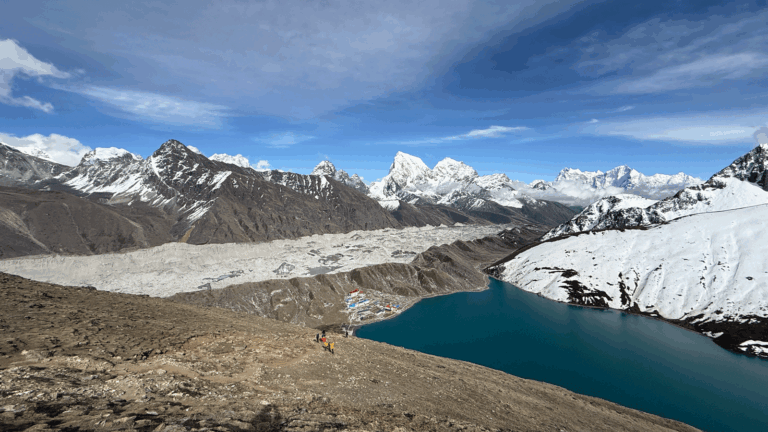
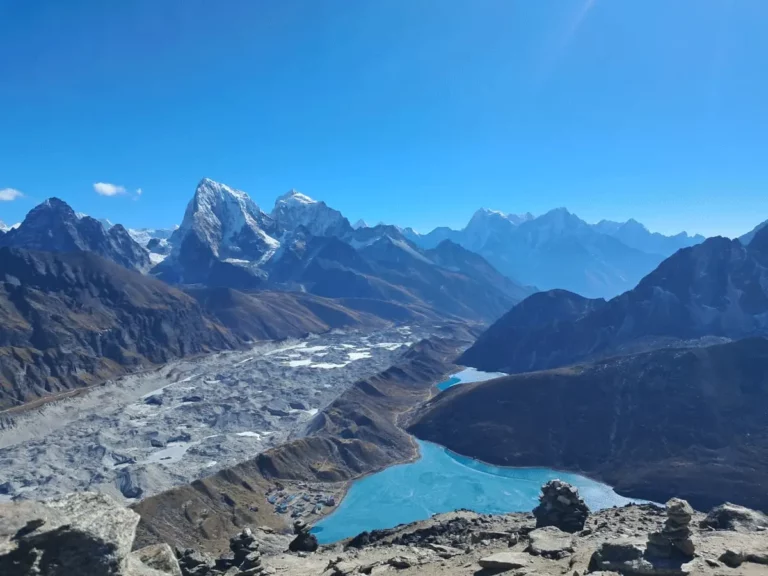
Landing at Lukla is like stepping into an open-air gateway to Nepal’s most iconic treks. While among the many popular Everest Region Treks, the classic Everest Base Camp route is the most popular, Lukla is also the main starting point for the popular Three Pass and Gokyo Ri trek.

Lukla Flight Tips for Everest Trekkers
When you’re heading to Everest base camp, flying into and out of Lukla is generally involved, unless you take an overland route. Here are some key tips to help manage your flights effectively:
- Book early morning flights: Weather is generally calmer in the morning, increasing your chances of a smooth flight.
- Fly from Ramechhap in peak season: During Spring (March- May) and Autumn (Sept- Nov), most flights depart from Ramechhap to avoid congestion in Kathmandu. Expect a very early departure at 2-3 AM.
- Add buffer days to your itinerary: Unpredictable mountain weather can delay flights, so keep 1 or 2 extra days in Kathmandu to avoid last-minute travel stress.
- Secure comprehensive travel insurance: Make sure your policy covers flight delays, cancellations, and emergency helicopter evacuation up to 6,000 meters.
- Pack light and follow weight limits: Airlines allow 10 kg for checked luggage and 5 kg for carry-on. Wear heavy items like boots and jackets on the plane.
- Request a left-side window seat: Enjoy stunning panoramic views of the Himalayas, including Mount Everest and Ama Dablam.
Catch your Flight to Lukla Confidently
Lukla Airport has long been widely regarded as one of the most dangerous airports, known for its dramatic conditions. And yes, the terrain looks wild even in photos, videos, and real flight. But with skilled pilots, strict flight protocols, and decades of operational experience, flying to Lukla is far safer than the internet makes it seem. Thousands of trekkers land here every year and return with beautiful memories.
So take the chance, grab the window seat, and enjoy one of the most incredible flights on Earth to start your adventure in the Everest region.