Drive through the scenic and winding Prithvi Highway from Kathmandu to Sotikhola.
Trek through the luscious forests of rhododendron, oak, pine, and spruce.
Explore the remote valleys, gorges, waterfalls, and Budhi Gandaki River.
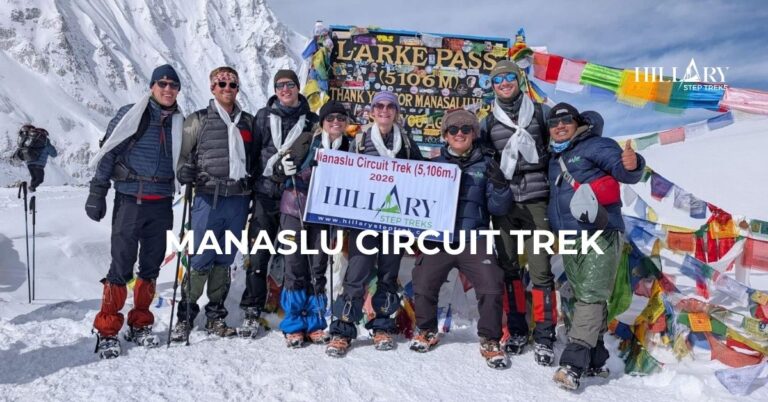
Cross the Larkya La Pass, which sits at 5106 meters.
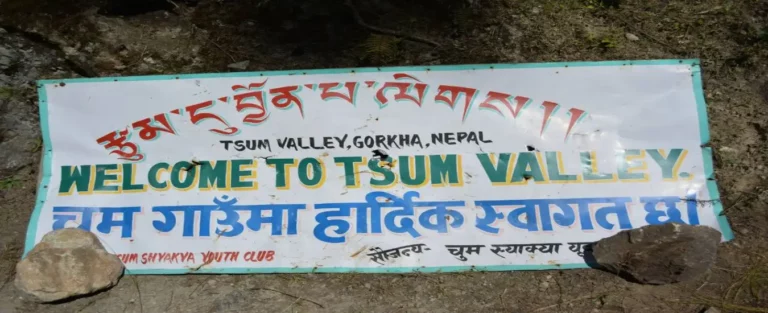
Explore the hidden gem, the Tsum Valley.
Pass by the age-old monasteries, stupas, gompas, and other religious sites.
Witness the magnificent mountains like Mt. Manaslu, Ganesh, Himchuli, and many more.
Experience the culture, tradition, and hospitality of local ethnic communities.
Manaslu Tsum Valley Trek Overview
Trek into the lesser-known and hidden gem of northern Nepal with 20 Days Manaslu Tsum Valley Trek. Despite the challenges, the trek is a once-in-a-lifetime experience that is sure to quench your wanderlust.
Lying between the Langtang and Annapurna ranges, Manaslu Tsum Valley is a paradise for trekkers, adventure seekers, and nature enthusiasts. The trek offers splendid views of Mt. Manaslu, Ganesh Himal, Shringi Himal, and many more.
You will traverse through remote valleys, picturesque villages, glaciers, and moraines. Also, discover the ancient Tibetan traditions and visit age-old monasteries and gompas like Mu Gompa, Panango Gumbam, Gurwa Gumba, and Mani Dhungyur.
Escape from bustling city life into the pristine lap of nature with Manaslu Tsum Valley Trek. The region is a hidden treasure filled with stunning landscapes, scenery, and cultural experiences. What can be better for adventure seekers than the challenging terrains and crossing the Larkya La pass at 5106 meters?
Explore the unspoiled nature of Manaslu Tsum Valley and get a glimpse at the region’s rich culture. We assure you that you will have the best trekking experience during the trek.
We will begin our journey by driving from Kathmandu to Soti Khola (710 meters) by local bus. The bus will travel through the Prithivi Highway, passing by green gills, rivers, villages, and terrace fields.
The road condition is smooth until Arughat, after which we must travel off-road. The ride becomes bumpy, and after 7-9 hours of driving, we will reach Soti Khola.
Day
02
Trek from Sotikhola to Machha Khola
5 hours trekB.L.DTea house890m/2,920ft
We will trek to Maccha Khola (890 meters) on this day. We will cross a suspension bridge and head towards the Sal forest. Along the way, we will pass by several settlements and terraced fields.
The trail widens after we pass a small Gurung village, Lapubesi. Then, we will follow the sandy riverbed while witnessing the Ganesh Himal. Finally, we will reach Maccha Khola.
Day
03
Trek from Machha Khola to Jagat
8 hours trekB.L.DTeahouse1,400m/4,593ft
We will leave Maccha Khola and head towards Jagat (1400 meters). The first village we will come across after passing Thora Khola is Khorlabesi. The trail requires you to climb uphill and also downhill.
After a while, we will reach the famous Tatopani, known for its natural hot springs. We will cross the Budhi Gandaki and Yaru River. Then, after an uphill ascend, we will reach Jagat. It’s a 7 to 8-hour trek.
Day
04
Trek from Jagat to Lokpa
7 hours trekB.L.DLodge2,040m/6,693ft
Today’s trail follows the Ghata Khola, crossing a bridge and ascending on a rocky ridge to Salleri. We can witness Mt. Sringri as we trek. Then, the trail will descend to Sirdibas, requiring us to cross a long suspension bridge. From here onwards, the trail begins to ascend.
After an hour’s climb, we will pass by Ekle Bhatt. The route goes through the pine forests, and then the trail divides into two. One goes to Tsum, while the other goes to Manaslu. We will take the right path towards Tsum Valley and reach Lopka (2040 meters). The trek takes 6 to 7 hours.
Day
05
Trek from Lokpa to Chumling
7 hours trekB.L.DTeahouse2,386m/7,828ft
As we leave Lokpa, the trail enters the forest of rhododendrons and pines. We will ascend and descend along the way. Then, we will come across a small suspension bridge that leads to Chumling (2386 meters). En route, you can witness Mt. Boudha and Ganesh as we cross the bridge and pass by a small stone wall.
Chumling is a charming village also known as Lower Tsum. It is home to three religiously significant monasteries, i.e., Panango Gumbam, Gurwa Gumba, and Mani Dhungyur. There is also a field with a large chorten in the middle. Trekking from Lokpa to Chumling takes 4 hours.
Day
06
Trek from Chumling to Chhokang paro
5 hours trekB.L.DLodge3,031m/9,944ft
Today, we will again gradually ascend to higher elevations. Our destination is Chhokangparo (3031 meters). The trail first descends to Domje and follows the Syar River.
From here onwards, the trail ascends through dense forests, wooden bridges, and several settlements.
Finally, we will reach Chhokangparo. Chhokangparo is a beautiful village that lies in the upper part of Tsum. The trek duration is 4 to 5 hours.
Day
07
Trek from Chhokang Paro to Mu Gompa
8 hours trekB.L.DLodge3,700m/12,139ft
Our destination for the day is Mu Gompa (3700 meters). It is a scenic trek that takes us close to the Tibet-Nepal border. We will continue our walk on the valley’s west bank. Trekking from Chhokangparo to Mu Gompa takes 7 to 8 hours.
Mu Gimpa is the largest monastery in the region, with more than 100 monks. It is the highest point of Tsum Valley. Therefore, it is also known as upper Tsum. You can see religious paintings and statues. Similarly, you can sense the Tibetan influence here.
Day
08
Trek from Mu Gompa to Chhokangparo
7 hours trekB.L.DTea house3,031m/9,944ft
After visiting the beautiful Mu Gompa, we will head back to Chhokangparo. From head towards Manaslu. We will trek past small settlements, passing by the Siyar River and alpine meadows. Trekking from Mu Gompa to Chhokangparo takes 7 hours.
Day
09
Trek from Chhokangparo to Lokpa
8 hours driveB.L.DTeahouse2,040m/6,693ft
On this day, we will retrace our steps back to Lokpa. We will trek through the forests and settlements. Similarly, we will descend to Chumling. The trek takes 7 to 8-hour trek.
Day
10
Trek from Lokpa to Deng
6 hours trekB.L.DLodge1,860m/6,102ft
From Lokpa, our rocky uphill climb will begin. We can witness the Sringi Himla at a distance. We will trek on a difficult path alongside the Shair Khola’s bank. Then, we will enter the bamboo forest after crossing the Budhi Gandaki River.
As you get closer to Deng (1860 meters), Mt. Manaslu and Ganesh Himal will slowly appear. You will cross the Deng River for the last stretch and reach Deng. It is a 5 to 6 hours trek.
Day
11
Trek from Deng to Namrung via Ghap
8 hours trekB.L.DTeahouse2,540m/8,333ft
We will head to Namrung (2540 meters) via Ghap for this day’s trek. First, we will begin with an uphill climb from Deng to Rana village. Then, we must cross several bridges on top of the Budhi Gandaki River.
The trail gets more challenging as it gets crisscrossed before reaching Ghap. After reaching Ghap, we will continue our trek into a steep valley. The trail will gradually ascend. Similarly, it goes through the forests of rhododendrons and bamboo.
En route, you will come across a waterfall and a wooden bridge. We will finally arrive at Namrung village after a 7 to 8-hour trek.
Day
12
Trek from Namrung to Lho Village
5 hours trekB.L.DLodge3,180m/10,433ft
This day’s destination is the Lho Village (3180 meters). It is an uphill climb from here onwards. The trail passes through the Simnang side valley while passing by the Hinang River.
The gorgeous mountain view will continue to keep us company. We will pass by Sho and then Shrip. The trail turns into a steep climb when we finally reach Lho.
It is a challenging hike that takes 4 to 5 hours. We can get a clear view of Manaslu North and Naike Himal from Lho village. Similarly, the Ribung monastery lies above the village. You can also witness the beautiful sunrise and sunset from Kani near Lho village.
Day
13
Trek from Lho to Samagaon
4 hours trekB.L.DLodge3,540m/11,614ft
We will leave Lho village and head to Samagaon (3540 meters) next. En route, we will traverse Sahyala village and several Tibetan settlements. Similarly, we will also come across gompas, yaks, and green pastures. It is a 4-hour trek to Samagaon. It is a large village where we will have an acclimatization or rest day.
Day
14
Rest Day and Acclimatization at Samagaon
Acclimatization DayB.L.DLodge3,540m/11,614ft
We will take an acclimatization day today. It allows our body to adapt to the higher altitude and its surroundings. Samagaon is a beautiful and large village. You can explore or hike to the Birendra Tal, Anie Gompa, or Pungyen Gompa. There is also a glacial moraine near the Samagaon.
Day
15
Trek from Samagaon to Samdo
4 hours trekB.L.DTeahouse3,875m/12,713ft
With our bodies ready to climb higher elevations, we will head to Samdo (3875 meters). En route, we can see yak pastures and enter the juniper forest. The trail passes by the Manaslu glacier and follows the Budhi Gandaki River. After crossing a wooden bridge, we will reach Samdo village.
The Samdo village is also known as the Tibetan Refugee Village. So, you will see a lot of Tibetan influence here. The village is also known for traditional yak herding.
Day
16
Trek from Samdo to Dharmasala
5 hours trekB.L.DTea house4,460m/14,633ft
We will leave Samdo village following the wide trail towards the Budhi Gandaki River. Then, after crossing the river, the trail enters the juniper forest. As we continue moving forward, the Larkya Glacier will come into view. Similarly, we can also come across Manaslu Glacier and Manaslu ice fall.
Then, we must climb a valley before reaching Dharmasala (4460 meters). It takes 4 to 5 hours to trek from Samado to Dharmasala. The village offers magnificent views of Mt. Manaslu, Simnang Himal, Nagdi, and many more.
Day
17
Trek from Dharamshala to Bhimtang via Larkya La Pass
7 hours trekB.L.DTeahouse5,106m/16,752ft
We will climb to the highest point of the Manaslu Tsum Valley Trek, the Larkya La Pass. We will walk towards Larkya Glacier. From here, the trail gets rocky and rugged. Then, we will descend to four frozen lakes and ascend to Larkya La Pass again.
The pass sits at an elevation of 5106 meters. You can view mountains like Annapurna II, Humlung, Cheo Himal, Minjung, and others from the top of the pass. Again, we must cross several steep and narrow sections with rugged terrains. The tail will descend and become gentler as we cross another grassy moraine.
From here onwards, the trail becomes more straightforward. We will traverse a meadow and a mani wall before reaching Bhimtang (3590 meters). Trekking from Dharmasala to Larkya La Pass to Bhitang takes 7 to 9 hours.
Day
18
Trek from Bhimtang to Tilije
B.L.DLodge2,300m/7,546ft
We will start descending to the lower region from Bhimtang. We will slowly start our descent as the trail goes through the forest. Then, the trail follows the Dudh Koshi River. Similarly, we will have to cross steep sections while descending. The trail passes by Hompuk, Gho, and several other villages. After 6 to 7 hours of hiking, we will arrive at Tilijie (2300 meters).
Day
19
Drive to Besisahar
6 hours driveB.L.DLodge760m/2,493ft
We will leave Tilijie on a shared jeep to Besisahar (760 meters). The drive duration takes 5 to 6 hours.
Day
20
Drive to Kathmandu from Besisahar
7 hours driveBLodge1,400m/4,593ft
Our Manaslu Tsum Valley Trek will end on this day as we head back to Kathmandu. We will be traveling on a tourist bus. The drive can take 6 to 7 hours, depending on the traffic. Once we arrive in Kathmandu, we will say goodbye with a farewell dinner.
What’s Included
Accommodation
19 Nights of Lodge accommodation During the trek( Twin Sharing basis)
Meals
Three meals a day (Breakfast, Lunch, and Dinner/main course along the trek).
Transportation
Kathmandu to Sotikhola by Local bus (If you ask, we can arrange a private jeep at an extra cost)
Tilije/Dharapani to Besisahar by local Sharing jeep.
Bensisahar to Kathmandu Tourist bus (If you ask, we can arrange private transportation at an extra cost).
Extra
Hillary Step Treks Duffel bag and Sleeping bag (return after trek)
Hillary Step Treks T-shirt and warm hat
Government registered License holder trekking guide and required Porter (A porter for 2 trekkers) Including Salary, Food, Insurance, Accommodation, Transportation, etc.)
Legal documents (MCAP permit, Manaslu restricted area permit, and ACAP).
All gov taxes.
Manaslu Tsum Valley Trekking Map
First aid medical box with oximeter.
Some fresh Fruits
Farewell Dinner in Kathmandu end of the trek
What’s Not Included
International flight costs.
Nepal entry visa fees at Tribhuvan International Airport
All accommodations and meals in Kathmandu, before and after the trek
Extra night accommodation in Kathmandu due to early arrival, late departure, or early return from the trek.
Personal expenses – shopping, snacks, boiled or bottled water, hot (tea/coffee) and cold drinks, hot shower, alcohol, Wi-Fi, telephone calls, battery re-charge fee, laundry, extra porters, etc
Personal clothing and gear.
Travel insurance which has to cover emergency high-altitude rescue and evacuation (compulsory)
This combined Manaslu Tsum Valley Trek route runs on limited departures due to special permits and logistics. The departure dates shown are for travelers joining a shared group trekking experience. If your travel dates are different, we are happy to arrange a private departure for you and your group.
The Manaslu Tsum Valley Trek is physically strenuous. The trek route goes through remote and restricted areas. The trail gets more difficult as you ascend to the higher elevation. The terrain is rocky, uneven, and filled with steep sections. Although you do not need technical climbing skills, you still need ample physical stamina and endurance.
The 20 days trek duration is no joke. You must walk 6 to 7 hours daily on average during the trek. The high elevation further makes the trek arduous. Without proper preparation and acclimatization, there is a risk of altitude sickness. Despite being a moderately difficult trekking route, trekkers must be physically and mentally prepared for the Manaslu Tsum Valley Trek.
Equipment checklist for Manaslu Circuit Trek
Trekking on the off-beat path is an extraordinary experience. To make it more remarkable proper equipment is required. Thus, our HST representative provides you with the necessary equipment checklist and mostly preferred lightweight and they are mentioned below:
Upper Body
A long-sleeve thermal base layer
Trekking shirt
Insulation layer
fleece jacket
Warm Down Jacket
Gloves
waterproof jacket
T-Shirt lightweight
Head
Beanie and ear warmers
Sunhat & Scarf
Headlights with extra batteries
Face
Sunglasses with UV protection
Sunscreen
Dust Masks
Lip Balm
Face /Body wipe
Legs & Boots
Trekking Pants two pairs
waterproof jacket
Trekking boots
Sport Shoes
Gaiters
Crampons (If snow or Ice)
Slippers
Thermal Leggins
Underwear & thick Socks
Essentials Gear
Trekking pole
Sleeping bag
Towels
Raincoat
Water bottle
Backpack or Day pack
Toiletries
Quick drying towel
Toilet paper
Toothbrush
Toothpaste
soap
Shampoo
Small mirror
Nail cutter
Personal accessories
Money
Camera
Phone
Watch
Power bank
Extra batteries for the Camera
Extra
Diary & Pen
Books
Extra Passport copy and Photos
Binocular
Firsts Aid Kits
Note: The above list can be customized as per the seasons and necessity of the trekkers.
The Manaslu Tsum Valley Trek is a moderately difficult trekking destination. It requires a good level of physical fitness. Trekkers must climb uphill and downhill on varied terrains, including narrow and steep sections. Similarly, trekkers need to have good physical stamina and endurance.
Is there any age restriction for the Manaslu Tsum Valley Trek?
There is no age restriction for the Manaslu Tsum Valley Trek. However, trekking agencies can have an age restriction. The minors (below age 18) need parental consent for the trek. It is also essential to consider the physical challenges and risks of the high altitudes.
When is the ideal time for the Manaslu Tsum Valley Trek?
The ideal time for the Manaslu Tsum Valley Trek is from March to May (spring) and September to November (autumn). These months offer stable weather, warm temperatures, and clear visibility. The trails are also well-defined and safe, as there is a very low chance of rainfall.
How long does the Manaslu Tsum Valley Trek take?
The Manaslu Tsum Valley Trek takes 20 days to complete. However, you can customize the itinerary to shorten the trek duration. Hillary Step Treks offers flexibility to match your preferences. However, the Manaslu Tsum Valley Trek is difficult and takes you to high elevations. Acclimatization is necessary for a safe trekking experience.
Is travel insurance necessary for Manaslu Tsum Valley Trek?
You must have travel insurance for the Manaslu Tsum Valley Trek. The travel insurance should include medical and emergency expenses. Similarly, it should consist of helicopter rescue and evacuation at high elevations for unforeseen accidents.
What is the highest point of the Manaslu Tsum Valley Trek?
The highest point of the Manaslu Tsum Valley Trek is at Larkya La Pass. It sits at 5106 meters (16752 feet) above sea level. The pass offers panoramic views of majestic mountains like Manaslu, Hinchuli, Cheo Himal, and other surrounding peaks.
Is there a risk of altitude sickness during Manaslu Tsum Valley Trek?
Yes, there is a risk of altitude sickness during the Manaslu Tsum Valley Trek. The trek’s highest point is Larkya La Pass, which is at 5106 meters. The atmosphere’s oxygen level lowers, leading to trekkers experiencing altitude sickness. Thus, it is necessary to acclimatize during the trek.
What permits do I need for the Manaslu Tsum Valley Trek?
The Manaslu Tsum Valley Trek requires four permits, including a special restricted area permit. It includes a TIMS (Trekkers Information Management System) card, a Special Restricted Area Permit for Manaslu (Manaslu RAP), Manaslu Conservation Area Project (MCAP), and Annapurna Conservation Area Project Permit (ACAP).
Is it necessary to hire a porter for Manaslu Tsum Valley Trek?
The Manaslu Tsum Valley Trek is a physically demanding trek. The trek duration is 20 days, and trekkers must walk 5 to 6 hours daily on average. Trekking with a backpack adds more physical strain on trekkers. It can also be dangerous while crossing steep and narrow sections. Thus, it is highly recommended that you hire a porter.
What accommodation facilities are available during the Manaslu Tsum Valley Trek?
The Manaslu Tsum Valley Trek takes you to the remote region of northern Nepal. Hence, the facilities and infrastructure is limited. So, you will find tea houses, lodges, and homestays with basic facilities. There are no luxurious accommodations available. So, make mental preparations and manage your expectations.
Thank you, Hillary Step Treks and Hari. We were 3 of us went to Tsum Valley and Manaslu Trek with our Guide (Hari) and 2 other porters. Our guide is very frank, helpful, experienced, and knowledgeable. He knows very well about the route and local culture. our porters are also very strong frank and helpful. So, if any of you are planning to Visit Nepal, I highly recommend them.
I did a 3-week trek with Hari and his team around Manaslu and the Tsum Valley Circuit. The trek itself, the scenery, mountains, valleys, rivers, people,..were simply Epic. Hari and our porters (Siri his nephew and Chitra his uncle) were wonderful and I a great time talking and joking with them. As for the dificulty of the trek, i would consider most days of moderate difficulty with a few hard ones now and then like pass-day. In Tsum Valley we did several interesting homestays and stayed one night in a Tibetan monastery (Mu Gompa). At 3700m, and placed on a ridge, it was very windy and chilly but very interesting to spend the night there nonetheless. All in all I enjoyed the trek a lot and would like to come back for a spring season trek. About Hari and his team I have nothing but praise. They're very easy-going, well-organised and fun to be around with. In other words, you'll be in very good hands!
Discover the essential travel requirements for Nepal, including visa procedures, current travel restrictions, and health and safety guidelines. Our travel expert will guide you through the latest entry requirements based on your departure country and passport, ensuring you’re prepared for your Himalayan adventure.
Important Update Regarding the Recent Flooding in Nepal
Our thoughts are with everyone affected by the recent disaster in Rasuwa and along the Bhotekoshi–Trishuli river corridors.
We are deeply saddened by the loss of lives and extend our heartfelt condolences to the families who are grieving. We also wish a quick and full recovery to those who have been injured or affected. Our thoughts are especially with the local communities facing this difficult time.
A note for our trekking guests
We want to reassure everyone travelling with Hillary Step Treks that our team and our guests are safe, and the trekking itineraries currently planned with us are not affected by the incident.
Our guides and operations team are actively monitoring conditions and staying in contact with our local partners. We will continue to assess each trip carefully and make responsible decisions whenever conditions require it.
Your safety comes before everything else.
If you have an upcoming trek with us or are planning a trip to Nepal and would like to discuss your travel plans, please contact our team directly: